Lyceum & Book Club - Week 16 - Lecture Notes - Slavery and the Netherlands
- Mar 31, 2022
- 13 min read
Slavery went hand in hand with colonization and economic advancement - not just the advancement of states but of those within a state who profited directly or indirectly from the advantage that cheap/ no expense slave labour afforded them to garner as much of the resources and wealth as they could. And if you were able to gain the benefit while claiming non-involvement because you just built the ships for the trade or you just financed the money for the venture or you just kept quiet or made laws that accommodated certain sectors and gave carve outs to those that benefited the group that included you - because you didn’t want to rock the status quo that you enjoyed. Each link in the chain that says those who are vulnerable deserve to be used as a tool for those who are stronger is as guilty in perpetrating that mindset that allows the worst atrocities at the end point of that continuum to happen.
The Netherlands gained their “Golden Age” at the expense of those they enslaved or aided in the enterprise of slavery.
When private enterprises/ individuals are used to boost state agenda (and the state then takes private enterprises’ needs into consideration to either protect those non-state interests or advance private enterprise goals) then the state becomes responsible for the actions that private enterprise/ individual does.
Going Dutch - The Netherlands' slave trade - PTWL - 7.39 min
----------------------------------------
Ever since Dutch traders brought 20 captive Africans to Jamestown, Va., in 1619, slavery has been entwined with American history--shaping it, tarnishing it, burdening it with the legacy of truths rarely told. - WP
———————
From justice info.net
In the 17th century the Dutch republic was briefly the largest slave trader. And while the republic’s involvement decreased later, slavery was still an important economic driver. Some 19 percent of imported goods were made by enslaved people and an estimated 5 percent of the national economy around 1770 was taken up by ‘slave-related activity’.
———————————
From hxumanityinaction.org
Slave labor created vast sources of wealth for the Dutch in the form of precious metals, sugar, tobacco, cocoa, coffee, and cotton.
The Dutch West India Company (WIC), a chartered company of Dutch merchants, was established in 1621 as a trade monopoly with control over the African slave trade, Brazil, the Caribbean, and North America. The company had offices in Amsterdam, Rotterdam, Hoorn, Middelburg and Groningen, among which Amsterdam served an important role as the largest financier. One fourth of the Africans transported across the Atlantic by the WIC were moved in slave ships from Amsterdam.
Following the 1634 capture of Brazil from the Portuguese, The Netherlands became an active player in the transatlantic slave trade. In The Dutch Slave Trade 1500-1850, P.C. Emmer argues that the Dutch played a significant role in the development of slavery during the 17th century partly because of their use of slaves, but also critically because of their promotion of sugar plantations. The labor-intensive harvesting of sugar created an urgent need for slave labor, particularly in the French and English colonies of the Caribbean.
Dr. Leo Balai, a historian and author of the book Slave Ship De Leusden, stresses the importance of Amsterdam in advancing the slave trade, particularly after it became a co-owner of Suriname in 1682. The city of Amsterdam, together with the WIC and the van Aerssen van Sommelsdijck family, formed the Society of Suriname to run the country’s plantations, bringing increasing numbers of slaves to work there. The WIC also used the nearby island of Curacao as a place from which to sell slaves to other colonies.
Almost all of the money that financed slave plantations in Suriname and the Antilles came from bankers in Amsterdam, just as many of the ships used to transport slaves were built there. Many of the raw materials that were turned into finished goods in Amsterdam, such as sugar and coffee, were grown in the colonies using slave labor and then refined in factories in the Jordaan neighborhood of Amsterdam.
The sinking of De Leusden serves, in Balai’s words, as “horrific proof of how the slaves were seen as cargo or cattle rather than as humans.” In 1738 the Amsterdam-owned De Luesden began to sink in the Marowijne River in Suriname. Of the 716 slaves on board, only 16 survived after members of the crew ordered the slaves below deck and nailed the escape hatches shut before abandoning the sinking ship. De Leusden was one of the last Dutch ships to transport slaves after the WIC lost its prominent position in the slave trade in 1713.
Beginning in the 17th century, enslaved men and women began to visit Amsterdam, and it was not uncommon for wealthy plantation owners to bring their most loyal black servants back from the colonies to visit the city. Afro-Amsterdammers have been a part of the city since then, evidenced, for instance, in the painting of two black men in the 17th century by the famous Dutch artist Rembrandt van Rijn. However, black people remained an anomaly in The Netherlands in the centuries that followed, a fact made stark by the exhibition of 27 Surinamese “Maroons” at the 1883 World Fair in Amsterdam. The Maroons—former slaves who escaped and lived in the Surinamese bush—were captured and brought to The Netherlands for six months as a public exhibition.
———————————
From wiki
Slavery in the Netherlands
Atlantic Slave Trade
Already in 1528 an asiento or contract was made between the rulers of Spain and assumingly the Southern Netherlandish merchants Willem Sailler and Hendrink Eynger, to transfer during the next four years 4000 slaves from Africa to the Caribbean. However, the slave trade was originally seen as immoral in the Netherlands. It went against Christian norms and values, therefore people initially refrained from engaging in the slave trade.
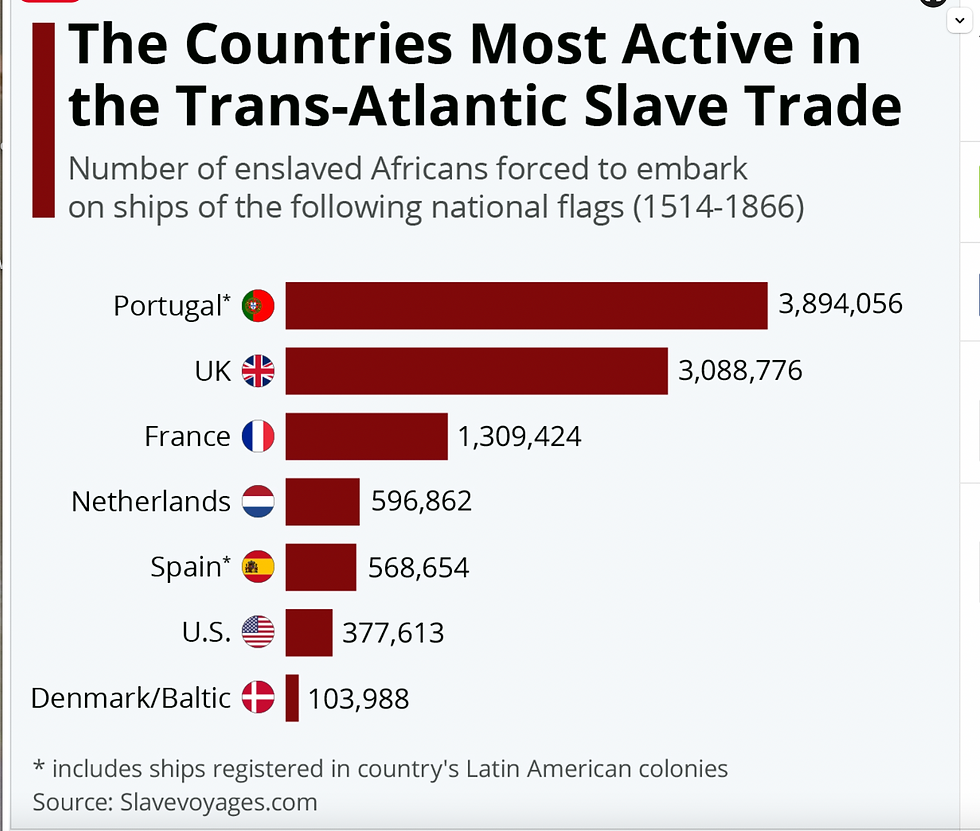
The share of the Dutch Republic in the Atlantic slave trade was on average around five per cent, at least 500,000 people.The slave trade by the Dutch West India Company (WIC) has in their starting years contributed to the status of the Netherlands as an economic world power.
During the fight against the Spanish and the Portuguese, privateering was legal. This has been the main goal and source of income for the Dutch West India Company since their establishment in 1621.
Between 1623 and 1636, 547 Spanish and Portuguese ships were hijacked. After this, the Groot Desseyn was developed, the big plan.
The Groot Desseyn (Dutch for "Grand Design") was a plan devised in 1623 by the Dutch West India Company to seize the Portuguese/Spanish possessions of the Iberian Union in Africa and the Americas, in order that the Spanish would not collect enough money for their war against The Netherlands.
By taking over the slave trade the Portuguese sugar cane trade from Brazil could be undermined. With the capture of a Spanish treasure fleet during the Battle in the Bay of Matanzas in 1628, sufficient money was available to carry out the Groot Desseyn. Between 1630 and 1634 Recife and a large part of the Brazilian coast was conquered, this became Dutch Brazil.
In 1637, Fort St. George in Elmina on the African Gold Coast (in the Gulf of Benin) was captured. this was till then the greatest Portuguese slave trade stronghold. In the centuries that followed, this fortress would become one of the centres of the WIC's slave trade. In 1641 Luanda (located in what is now Angola) was conquered from the Portuguese. Around 1700, the WIC owned a dozen trading fortresses on the West African coast.
The Dutch slave trade grew to sizable proportions. To alleviate ethical concerns about slavery raised by Christians, it was argued that in Genesis 9 it states that descendants of Ham are cursed into slavery, since Ham's descendants are interpreted by some as having populated Africa.
To maintain the sugar production, many Portuguese plantation owners in the conquered part of Brazil were able to keep their plantation. Private slaves were required for this. This signaled a change in the stands about the slave trade; non-Christians could be sold as slaves.
From 1640 the slave trade with Brazil began to decline, and the trade was shifted to the Spanish colonies in America. Initially, Dutch traders transported slaves to Buenos Aires and Rio de la Plata in present-day Argentina, later the Caribbean also became the target of the slave trade.
When Brazil was recaptured by the Portuguese in 1654, there were already some 25,000 slaves brought over. After this reconquest, the sugar cane cultivation was transferred to the Caribbean and then in 1634 conquered Curaçao, which then became the Dutch collection point for slaves. After the British conquest of Jamaica in 1655, it became an important transfer market for slaves to the Spanish colonies. New slave buyers were also found among the English and French who grew tobacco on the islands they conquered in the Caribbean and Virginia, though most slaves went to Suriname, which from 1668 was permanently owned by the Netherlands until its independence in 1975.
Slavery on Curacao
In 1662 Spain made an asiento with Domingo Grillo and Ambrosio Lomelino to trade slaves from Africa. Grillo and Lomelino hired the WIC to transport slaves from the African coast to South America. Curaçao would function as transfer port.
On Curaçao, the slaves were subjected to a quality control. Slaves were assessed according to a so-called pieza de Indias, an evaluation of a slave's labour capacity. Then the slaves were sold to Spanish traders and transported to the Spanish colonies. Due to the asiento trade, the Dutch Republic had between 1660 and 1690 roughly 30% of the total slave trade.
The Coymans asiento became an important factor in the Dutch slave trade. Balthasar Coymans (1652–1686) led a branch of the Dutch trade house Coymans in Cádiz. He started a smear campaign against Venetian Nicolas Porcio who was at the time owner of the asiento. Coymans smear campaign was successful and in 1685 he obtained the monopoly to trade slaves to the Spanish colonies. He also enlisted the WIC to ship the slaves from Africa. This meant that the Spanish slave trade was entirely operated by the Dutch. Coymans died in 1686 and the Spanish lost faith in his successor and in granted the asiento back to Nicolas Porcio in 1688.
In 1689 the WIC declared Curaçao an open market. Merchants from all nationalities were now welcome, however now that trade could only take place on the free market, there was no trade possible with the Spanish colonies. Curaçao did no longer serve as a transfer port.
In the eighteenth century, the slave trade grew enormously. There were years in which more than 100,000 slaves were transported. However, the French and the British had taken over the position of the Dutch Republic. The Dutch Republic also found the slave trade to be very not profitable. This was partly due to the high mortality rate among the slaves when crossing the ocean; 30% of the slaves died on board the ships.
Note - death aboard Danish slave ships were much higher than aboard either the French or English, said due to lack of medical care provided during the passage.
It was not until 1708 that a supply contract was again offered to the WIC. During the War of the Spanish Succession, when the Netherlands again went to war with Spain and France, the French allies obtained the asiento from Spain. They approached the WIC, but the assignment did not go through because the WIC was afraid that Curaçao would be overrun by the French. When the asiento was granted to England in 1713, it meant the decline for trade via Curaçao; England had its own marketplace. Initially, the WIC had the monopoly on the slave trade. However, in 1730 the WIC gave up the monopoly on the transport of slaves from Africa to South America, and in 1738 also the monopoly on the slave trade. However, other slave traders had to pay recognition fees to the WIC. The Zeelanders in particular then took over the slave trade, in which the Middelburgsche Commercie Compagnie played an important role.
In 1713, immediately after the War of the Spanish Succession, Curaçao's central position as a regional slave market came to an abrupt end. Slave ships continued to arrive during the following years, but sales stagnated. In 1716 the number of unsold trade slaves (slaves supplemented under the WIC contract) rose to over 800. At the end of that year, a revolt broke out among trade slaves on the WIC plantation Santa Maria. This was quickly suppressed and the insurgents were captured and executed. After the uprising, protective slave legislation was enacted in Curaçao, which regulated, among other things, the provision of food rations and clothing, as well as working and rest times.
After the Seven Years' War of 1763, the slave trade with the Spaniards on Curaçao largely dried up. The slave trade continued despite the low profit margins, partly because many traders also had interests in plantations in Suriname. They needed the slaves for this, and the trade was therefore viable if a profit was made from the plantation.
Slavery in Suriname
John Gabriël Stedman, a Scotsman in Dutch service, described the Dutch slaveholders in Suriname as cruel, in the book Narrative of a five years' expedition against the revolted Negroes of Surinam in 1797. Descriptions of mistreatment by Dutch slaveholders and the images by William Blake were an important weapon for the mainly British advocates of the abolition of slavery.
The Society of Suriname collected a percentage of the income obtained from the domestic slave market. To avoid this, it was not uncommon to secretly bring slaves ashore.
Hanged by the rib was a punishment for a rebellious slave in Suriname. - illustrated in a painting by William Blake.
Slavery in Dutch Guiana
In the seventeenth century, Zeelanders had founded a colony on the banks of the River Berbice in present-day Guyana with plantations that were worked by African slaves. In 1763, the slaves of the Berbice colony led by Cuffy (Kofi, Coffy) revolted, which was eventually brutally suppressed with the help of six naval ships carrying 600 soldiers. This slave revolt was the first major revolt on the American continent.
Slavery Under the VOC (Dutch East Indies Company)
Within the context of Dutch history, the WIC is usually thought of when it comes to slavery. However, in Dutch East India Company (VOC) areas slaves were traded earlier than in WIC areas, and until the end of the eighteenth century more slaves were traded and held in VOC areas than in WIC areas. Around 1750 there were an estimated 75,500 slaves in settlements under VOC rule, compared to 64,000 slaves in areas under WIC rule.
Slavery continued to exist in the Dutch East Indies until decolonization (1949)
According to the traditional image, slaves in the East were mainly a status symbol. In fact this was not the case: In the East, too, slaves had mainly economic value and were used as labor force.
Abolition of Slavery
Meanwhile, the United Kingdom had banned the slave trade. When William I returned from exile, he placated the British by not allowing a continuation of the Transatlantic slave trade. This made them willing to give back the Dutch territories that had come under British protectorate during the wars, although the British retained the Cape Colony. Finally, the Dutch Trans-Atlantic slave trade was abolished in June 1814 by Royal Decree from William I. In May 1818, the United Kingdom and the Netherlands concluded an Anglo-Dutch Slave Trade Treaty, which, among other things, provided for the establishment of two Joint Courts of Justice to convict slavers who tried to evade the ban. However, the legal slave trade within the Caribbean continued as usual. The United Kingdom abolished slavery in 1833, resulting in slaves fleeing from St. Eustatius to the nearby British island of St. Kitts.
The Netherlands abolished slavery in stages, first in the directly governed parts of the Dutch East Indies with effect from 1 January 1860 (Law establishing the Regulations on the Policy of the Government of the Netherlands Indies), then in Suriname and the Netherlands Antilles on July 1, 1863 (Emancipation Act). On that day, about 35,000 slaves in Suriname and 12,000 slaves on the Dutch islands in the Caribbean were given their freedom.
Slavery continued to exist in some parts of the Dutch East Indies under indirect rule. On the island of Sumbawa this lasted until March 31, 1910, on Samosir even longer.
The abolition of slavery was referred to as 'emancipation'. Parties were organized in which King William III was presented as a key figure and benefactor of the freed slaves. The Dutch government paid compensation of 300 guilders per slave to the owner as compensation for the lost property (In the Dutch East Indies 50 to 350 guilders depending on the age of the slave). In total, the allowance amounted to almost 12 million guilders, about 10% of the government expenditure in 1863.
As an alternative to the use of slaves, contract workers were recruited from the Dutch East Indies (Javanese Surinamese), India (Indo-Surinamese) and China (Chinese Surinamese).
In Suriname the former slaves were placed under state supervision for a period of ten years and so they often continued to work on the same plantations. During this period, released plantation workers between the ages of 15 and 60 were obliged to conclude an employment contract. This measure was mainly intended to prevent the former slaves from leaving the plantations en masse, causing the plantation economy to collapse.
1814 – Transatlantic slave trade abolished.
1860 – Dutch East Indies – only in the directly administered areas.
1863 – Dutch West Indies – Emancipation Act abolishes slavery in the Dutch West Indies. slave owners receive compensation; freedmen in Suriname come under state supervision for ten years with a mandatory employment contract on the plantations.
1872 – Dutch Gold Coast – colony sold to Great Britain, where slavery had already been abolished.
1873 – Dutch West Indies – state supervision and compulsory employment contract abolished.
1877 – Dutch East Indies – Island of Bali
1910 – Dutch East Indies – Island of Sumbawa – March 31
1914 – Dutch East Indies – island of Samosir – probably the last part of the Dutch colonial empire where slavery was abolished.
Slavery in the Low Countries Themselves
Officially slavery did not exist in the European area of The Dutch Republic, however, in reality, the status of slavery in the Low Countries was a grey area. According to Leuven professor Petrus Gudelinus In the 16th century in Mechelen, an escaped slave was freed, because it was argued that slavery did not exist in the Low Countries.
In practice, this statement was often ignored; especially, Spanish and Portuguese merchants often took slaves with them to the Netherlands as servants. Later, mainly since the 18th century, slaves would come over with plantation owners, however, this affected relatively few people. On average between 1729 and 1775, 10 people of African descent (not necessarily slaves) would travel from Suriname to the Netherlands, of which most would return after a short stay.Although they could go to court to claim their right to freedom, this happened seldom. In cases where slaves did try to claim their freedom, they would often not succeed. In 1736 a slave named Claes escaped from Curaçao to the Netherlands as a stowaway on a ship. However, the Hoge Raad van Holland en Zeeland (regional supreme court) stated that he would remain a property belonging to Paulina Meyer, because he was a thief of himself and stolen property (res furtiva).
In 1776 the States General of the Netherlands published a resolution on the status of the 'unfree people' in the free Netherlands. In which it was emphasized that all people should in principle be recognized and regarded as free people. Slaves that travelled to the Netherlands have obtained their freedom legally and will be regarded as free people. There was an exception, because otherwise "the owners of slaves would often be deprived of their legal property against their will." This meant that if slave owners did not intend to free their property and their stay in the Netherlands was shorter than 6 months, or with special court permission up to 12 months, the slaves were not freed. If slaves were not sent back within this time window, they would have to be freed. It is unclear how consistently this rule was enforced.


Comments