Lyceum & Book Club - Week 15 - Lecture Notes on the Crusades in the Baltics
- Mar 20, 2022
- 2 min read
From the Book - “Latvia” by Stephen Baister/ Chris Patrick
"The greatest change in medieval Latvia came from the introduction of Catholicism, not Orthodox Christianity. Although the crusades to the Holy Land are well known, few people know of the crusade to the Baltics. At the time that the Pope initiated the Baltic crusade, however,it was considered as 'equal before God to the crusade to Jerusalem'.
Missionaries from Germany arrived in Riga, and in 1202, under Albert von Buxhoevden, the first Bishop of Riga, the Knights of the Sword, were founded to convert the region. Known as the Knights of the Sword because of the red swords and crosses on their white cloaks, the crusaders encountered strong resistance. Despite the avowed religious nature of the crusade, it quickly became apparent that economic motivation was paramount, and subjugation rather than conversion the aim. Subjugation was achieved relatively quickly in most of Latvia. The Livs (Livonians) were conquered by 1207 and most of the Latgals by 1214, although the Zemgals and Cours held out until later in the century.
—————————————————————
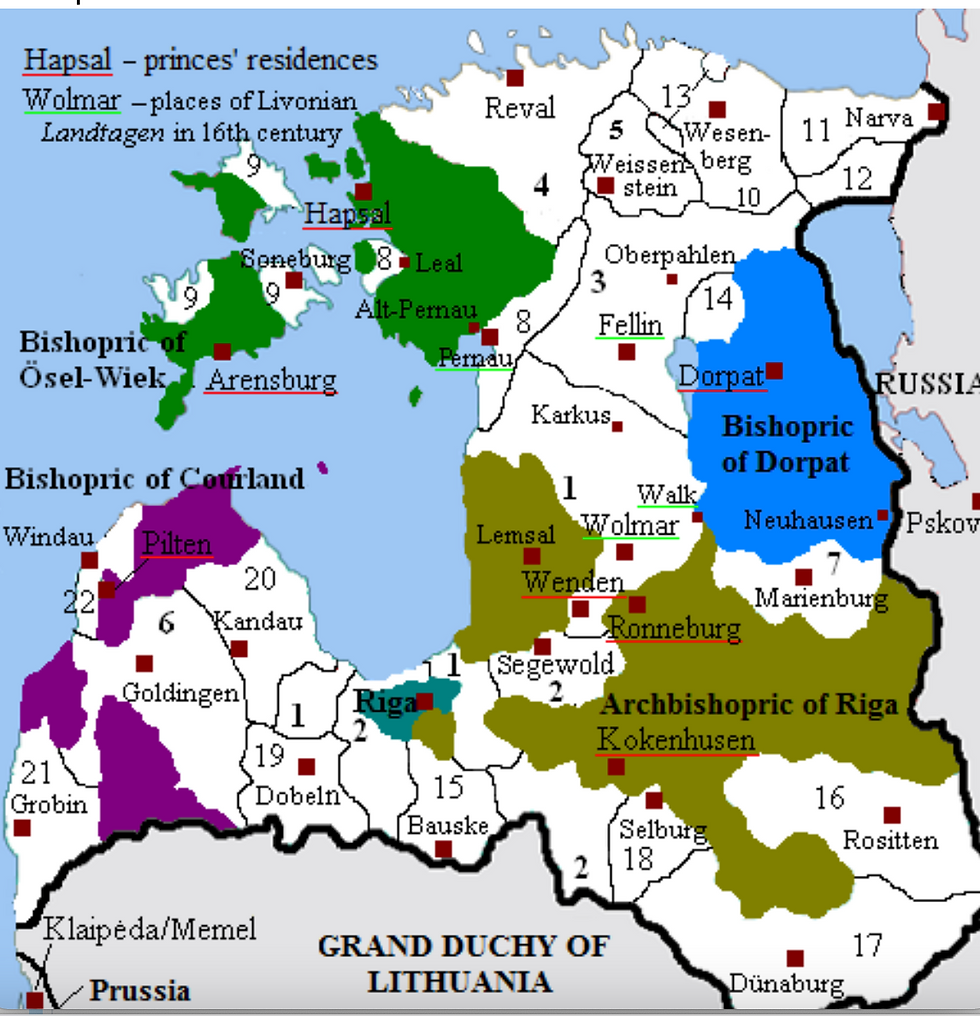
By 1290, the region had been subdued by the Livonian Order. Riga and a few other city territories became German ruled bishoprics and the rest of the land was ruled by the (German oriented) Livonian Order - together in a loose confederation called the Livonian Confederacy.
all of the areas in white are controlled by the Livonian Order, the Bishoprics are labeled.
———————————————
The new German rulers called the area they had conquered around the Gulf of Riga by the name of Livonia. Alongside the Germanic state, a number of small city states were formed, usually headed by a bishop. The ruling classes in these (newly established trade) towns were all German, while the artisans and farmers were the indigenous Latvians. Throughout the Baltic area, this division along ethnic lines could not be crossed: whatever their social status, people from the Baltic tribes could not become German. For this reason the ethnic identity of the Baltic nations remained strong throughout centuries of (German) domination. This is in contrast to the territory of Prussia, where native farmers were able to become Germans ,and former tribal identities were lost over the ensuring years.
By the middle of the 16th century, the Livonian Order and the system of semi-autonomous town states were weakening.The Reformation was beginning to threaten Catholic states. In 1554, the (head) of the Livonian Order, declared Protestantism, rather than Catholicism, the state religion.
Encouraged by growing peasant discontent and the loosening hold of the Livonian Order,Muscovy (forerunner to the Russian state),under the legendary Ivan the Terrible, invaded the eastern part of Latvia and Estonia.
To prevent Russian rule, the local aristocrats sought the protection of Poland-Lithuania. Meanwhile, across the Baltic Sea,Sweden had developed ambitions for foreign territory, and from 1593 this Protestant state began a war against Catholic Poland-Lithuania, fought mainly on Latvian soil. Sweden's victories led to almost a century of Swedish rule in Livonia, until the Russians finally took control of northern Latvia in 1710.
Throughout Latvia (from 1710) followed a period of Russian rule but with the German gentry overseeing the day-to-day administration. Baltic Germans tended to fill all of the prestigious places in the Russian army, as well as the government. Germans flourished, the Latvian population remained as serfs.


Comments