Lyceum & Book Club - Week 15 - Lecture Notes on Russia and Poland-Lithuania Rivalry
- Mar 20, 2022
- 6 min read
You will notice that the head of the Teutonic Knights is from the Hohenzollern family, that the Archbishop of Riga (in Livonia) is from the same family and the King of the Polish-Lithuanian Commonwealth is also from the same family.
This is how families built up a network of power. First sons inherited family property and titles, second sons were set up in military positions or placed into positions of power within the Church. Both were avenues for advancement and accumulation of property and power. And that could lead to corruption and incompetence within the military and Church ranks if those second sons were more interested in their personal advancement and not the profession they were in. If you got political leadership, military leaders and religious leaders all inherited and corrupt or incompetent because of this practice, you could really be in trouble as a society - and often were.
As a direct result of the German Reformation, the head of the Teutonic Knights,Albert of Hohenzollern (Albrecht von Hohenzollern),converted to Protestantism/Lutheranism and left the order in 1526 to found the Duchy of Prussia as part of the Kingdom of Poland(whose king was also his uncle). A number of fellow knights also converted and left as well. In consequence, the Teutonic Order collapsed as a regional enterprise and in its place a much smaller Teutonic Order focused on its own territory within the Holy Roman Empire (Livonia was not part of the Holy Roman Empire).
This left the Livonian Order in Livonia weakened without a powerful sponsor backing them up in the midst of a region that was rapidly changing and becoming unstable. As more of the population within Livonia converted to Protestantism internal divisions deepened. The Livonian Order found it hard to recruit new members without the well known branding of the Teutonic Knights. Its like joining a basketball team, everyone wants to belong to a well known, well connected, well funded team for the cache the name association gives you, for the social connections it offers, for the potential money such an association might offer - no one wants to belong to some no name minor team that will not offer them any of those benefits.
The knights and the bishop cities were constantly bickering over who should have more authority, which weaken the Livonian Confederacy. This left an opening for outside entities to take advantage and Livonia's neighbors were in an expansionist mood. All they needed was an opening.
Religion was a factor as far as the common people were concerned, but as far as the leaders who instigated the moves were concerned, it was all about power, which they were sure God intended them to have more of than anyone else, so in a way, for them it was religious also.
The King of Polish-Lithuania Commonwealth, Sigismund Augustus, was very conscious of Ivan IV of Russia (Ivan the Terrible)’s intentions concerning Livonia. He did not want Russia to expand into Livonia because it would allow a powerful rival to surround the Polish-Lithuania Commonwealth and it would cut off Poland-Lithuania's trade routes as Livonia served as a transfer hub. Sigismund wanted to make Livonia a vassal state to Poland-Lithuania just as Prussia was and provide a buffer to Russia.
Therefore, in the internal power struggles in Livonia, between the bishopric of Riga, Wilhelm von Hohenzollern, and the leader of the Livonian Order, Wilhelm von Furstenberg, over who had authority within the Livonian Confederacy, Sigismund supported his relative, Wilhelm von Hohenzollern, the archbishop of Riga. And what was a struggle for power was presented as a religious struggle to the common people.
When Sigismund's envoy was killed by Wilhelm von Furstenberg's son, Sigismund used it as an excuse to invade southern Livonia in 1557 and forced an agreement between all of the parties with the Treaty of Pozvol, which created a mutual alliance, with the primary target of the alliance being against Russia, locking them all into fighting for the Polish-Lithuania Commonwealth if Russia should invade Livonia.
Something you will also find, powerful countries prefer to fight battles against other powerful countries in lands other than the powerful states pushing the conflict; with crops and infrastructure destroyed and lives lost that are not their own. (As we will see, Russia, Polish-Lithuanian Commonwealth, Denmark, Sweden all will use Livonia as their sandbox to fight against each other - destroying Livonia society, killing or replacing her people, using up her resources and devastating her land, rather than their own)
Now let's pause for a little background on Russia's involvement in Livonia, so we can see how these events were all heading for the same juncture of war.
Ivan IV(Ivan the Terrible of Russia) saw as Russia's survival the ending of the continual harassment from Turkic tribes that surrounded her on the east and south and the establishment of a trade corridor that would run from the Caspian Sea to the Baltic Sea, giving Russia access to both southern and northern European markets and giving them a greater ability to bring in both skilled craftsmen and advanced weaponry from Europe.
This was a period that saw Russia rapidly expanding her territories and gaining strength as a force to be dealt with.They defeated/absorbed the independent city-states of Novgorod and Pskov by 1510, both adding resources to Russia's coffers and bringing Russia smack up against the border of Livonia. They defeated/annexed the khanate of Kazan in 1552 and the khanate of Astraknah in 1556. But they still lacked that lifeblood of commerce - a sea route to western Europe.
In 1550,Ivan built a port at Ivangorod on the eastern-Russian side of the Narva River, which drained into the Baltic Sea, in an effort to get around this obstacle. But both the port was too shallow to accommodate the sea going vessels and the Hanseatic League made every effort to keep trade from the port.
The conflict between Russia and the Western powers was exacerbated by Russia's isolation from sea trade because of lack of access to the lucrative Baltic sea routes. Neither could the tsar easily hire qualified labor from Europe. Compared with the Khante, Livonia "appeared to be an easy target."
In 1547, Hans Schlitte, the agent of Tsar Ivan IV, employed craftsmen in Germany for work in Russia. However all these handicraftsmen were arrested in Lübeck at the request of Livonia. The German Hanseatic League ignored the new port built by tsar Ivan on the eastern shore of the Narva River in 1550 and still delivered the goods into ports owned by Livonia. (And if the (German) Hanseatic League said no one was to use your port, no one would trade with you. It was that powerful of an entity)- newworldencyclopedia.com
Russia was effectively boxed in on all sides and could not advance her society or reach for any type of prosperity beyond a poor subsistence based state if the situation continued.
So Ivan reached back into history to turn the screws back onto those western powers.
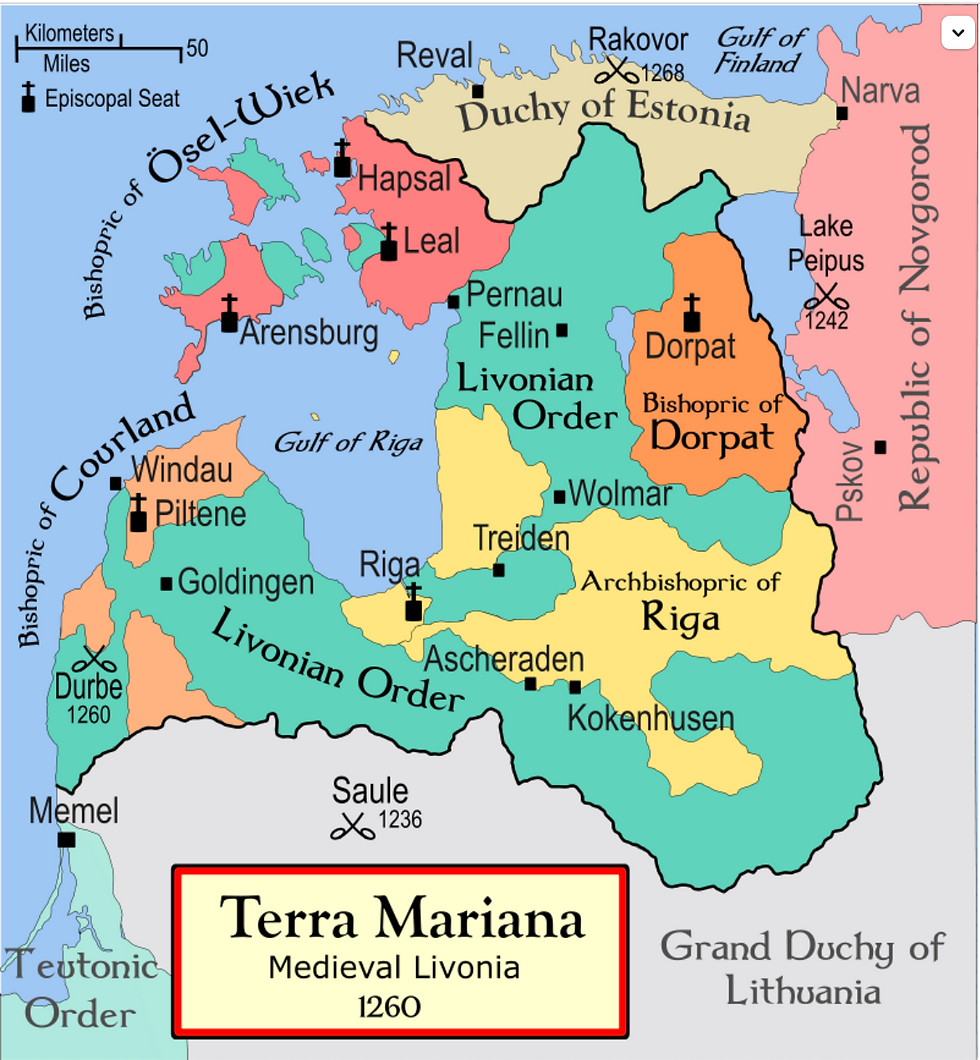
There was a brief 30 year period (1030 - 1061) in which the Russian prince, Yaroslav I the Wise, conquered the area around Dorpat in Livonia and ruled over Dorpat. Ivan declared the Bishopric of Dorpat owed Russia tribute in order to be allowed to keep Dorpat and surrounds because Yaroslav was a relative of Ivan's so the Bishopric actually belonged to him.
Of course this was all bullshit and would not have held up in a court of law.But remember,Russia was a much more powerful entity than the whole of Livonia (and that's if Livonia wasn't in the midst of internal divisions at this time). It didn't really matter if Russia said red was blue,Russia was bigger and more powerful.
The tribute was an outrageous amount Ivan knew the Livonians could not pay, but the Livonian Order agreed to the terms of the 1554 treaty Russia offered because part of the deal was a 15 year armistice. They agreed to pay the tribute. And part of that agreement was that Livonia would not enter into any alliance with Poland-Lithuania.
When 1557 came around,Livonia sought to renegotiate a lower tribute, because they did not have the money, but Ivan refused to even consider any new terms and sent the negotiators away.
And then the whole Riga episode (ending in a Poland-Lithuania alliance) happened.
Ivan felt this event served as justification for him to invade Livonia because he said Livonia did not live up to their end of the bargain - Livonia did not pay the agreed upon tribute and they entered into an alliance with Poland-Lithuania.
1558 - Ivan IV immediately negotiated an end to the conflict he had with Sweden and invaded Livonia instead.


Comments