Lyceum & Book Club - Week 14 - Lecture Notes - Prelude to the Fall of Constantinople
- Mar 20, 2022
- 6 min read
The Byzantine Empire was steadily losing the lands (in Anatolia) that provided them with the financial resources necessary to function and the recruits needed to protect itself from attacks. As they lost those lands and resources of men and funding, it left the rulers increasingly dependent upon creditors in Venice and at the mercy of capricious allies in Italy for any military aid they might provide the city of Constantinople. Such conditions were unsustainable.
----------------------
The Ottoman Empire was established in 1301 and conquered territory rapidly - from the Euphrates to the Danube. At the same time, the Byzantine Empire had gradually shrunk until it only consisted of a few territories and the area immediately in the vicinity of Constantinople.
Let’s look at the Ottoman army.
The Ottoman army consisted of the Janissaries and the bashi-bazouks.
The Janissaries were a highly trained corps that was the first standing army in Europe. It began as a unit made up of young Christian boys. Christian families were regularly culled of likely candidates who were involuntarily converted to Islam, taken to live with Muslim families where they learned the language, culture and faith of the Turks and then underwent a rigorous training program that produced a tight, highly disciplined unit of fighters.
The Janissaries were slaves but were paid a regular salary and given a pension upon retiring, making them a distinctive warrior social class who in time, became a powerful faction in Turkey politics.
The strain of the Ottoman's rapid military expansion meant that the Turks increasingly had to depend upon irregular troops, known as the bashi-bazouk (mercenaries, whose membership was not limited to Turks). They were armed and maintained by the government but not paid a salary. Therefore, anything they gained was by right of plunder. They were known for being brutal and undisciplined.

————————————————
The Cresent Moon and the Ottomans
There is a myth that the crescent moon you see on many Islamic national flags is because there was a crescent moon in the sky the night Constantinople fell - so representing the victory of Islam over Christianity.
But the crescent moon and star was a common symbol in the Hellenistic period of the west and has an even longer history in the ancient world of the near east (representing the moon and the rays of the sun or the morning star).In the ancient city of Byzantium, it represented their patron goddess.
It was adopted as a nation symbol by the Ottoman Turks for use on imperial insignias and used on their naval ships and became known as a symbol of Turkey's Islamic power in their conquests.
Since the late twentieth century when many Islamic movements adopted the crescent and star, it is now associated with the Islamic faith, but did not originate as a symbol of the faith itself.
—————————————
The state of Constantinople Leading Up to the Fall of Constantinople in 1453.
In the mid-14th century (1346 - 1349),before the city of Constantinople had time to recover from the assaults of the 13th century, the Black Plaque hit Constantinople, taking the lives of almost 50% of the population.
The Byzantine Empire had lost the valuable Anatolia territories from which they had been able to raise funds by way of taxes and conscript men to defend the city. They were now dependent upon sources in the west coming to their aid, both with troops and with funding. And western leaders, both secular and religious, had no interest and turned away from their pleas. Only those in Italy who had investments in the east they did not want to lose and knew they would if the Ottomans took Constantinople were interested in helping, but that was too little to make up the lack.
By the time Mehmed arrived at the city in the mid-15th century,Constantinople was still reeling from the previous two centuries of set backs. The Byzantine Empire had shrunk to just the city and a few isolated islands and territories, all the rest having been conquered by the Ottoman Turks previously. Constantinople was really an exhausted shell that no one was willing to invest in to resurrect. Power and focus had moved on to western Europe in Spain, England and France, the fervour of the Crusades had long since wained and interest in the east did not warrant the investment of resources needed to maintain that outpost.
Early in it's history,Constantinople had faced threats from northern Germanic tribes and competing religious factions from the west. After the rise of Islam in the Middle East, the main threats then switched to attacks from the east - first Arabs and finally Turks as the Ottoman Empire nibbled away at the Byzantine Empire until it finally consumed the whole thing.
——————————————
By the end of the Middle Ages, the Byzantine Empire was in decline.
The split in the Christian community between east and west - Roman Catholicism and Eastern Orthodox - led to infighting that weakened the eastern bulkhead of the whole faith as western competitors tried to take over their eastern rivals.
Energy spent by Crusaders in the 13th century trying to defeat the orthodox community in the east left the Byzantine Empire diminished in strength and yet she still held the mystique of being known as the gem of the Christian world that proclaimed itself superior to all others.
A dangerous combination that left her vulnerable to anyone seeking to gain quick status by way of conquest.
--------
A good part of the aggression between the two sides was generated by the Vatican, which was growing in power and insisted on pushing the issue of who had ultimate authority over the Christian body of churches.
In 1422, John VIII, Emperor of the Byzantine Empire was faced with a siege from the Ottomans that he was afraid he would not be unable to beat back. Desperate enough, that he went to Rome to seek protection from the Pope. In exchange for protection, he consented to the union of Greek and Roman churches.
The proposal was ratified by the Council of Florence in 1439 and attended by John and a delegation of 700 Byzantine leaders, including the Eastern Orthodox Patriarch of Constantinople. But just as it looked like the two sides might finally merge into one church, hardliners in the Greek/Eastern Orthodox Church in Constantinople (who would have lost their own personal power if the union had gone through) started a campaign to reject the proposal and it fell apart.
As with so many issues of competing factions who have the same roots, it was not so much the people who were in competition, as it was the leaders of the competing factions who stood to lose influence, power and the riches that went with it, who pushed the idea of irreconcilability into zero sum territory and ginned up the population for their own political purposes.
So here in 1453, not that many years after rejecting the union proposal of 1439,Emperor Constantine is writing the Pope and saying they will gladly implement the Union, if only Rome and the western nations would save Constantinople from the Muslim threat upon them.
But time had moved on, the world was now in a different place.
And here is where secular politics comes in. The Pope so wanted to take advantage of this opening and seal the deal to take over the eastern orthodox church and settle the issue of who was the head of the Christian Church. But we also were at a point in history where the secular governments of the west were trying to wrest power away from the Church. They were not about to give resources of troops and money to an enterprise that they saw as empowering the Vatican. The balance of power had shifted back to secular rulers and the Pope was limited in shaping world events.
There was also the fact because this was a period of transition the world over, what was happening in the east and what was happening ecclesiastically - both internal and between the Church and secular rulers was also happening in the west. It was like a game of musical chairs, with everyone trying to grab a piece of the pie before the music stops.
Every one of those western states were involved in conflicts to settle their borders and/or who was to rule. None of them had men or resources they could spare to send off anywhere at this point in time. But especially not for Constantinople a rival they resented and looked down upon as a backwater that had nothing to do with them.
Until after, when it was too late.
————————————
Let’s look at the leader of the Ottomans - Mehmed II.
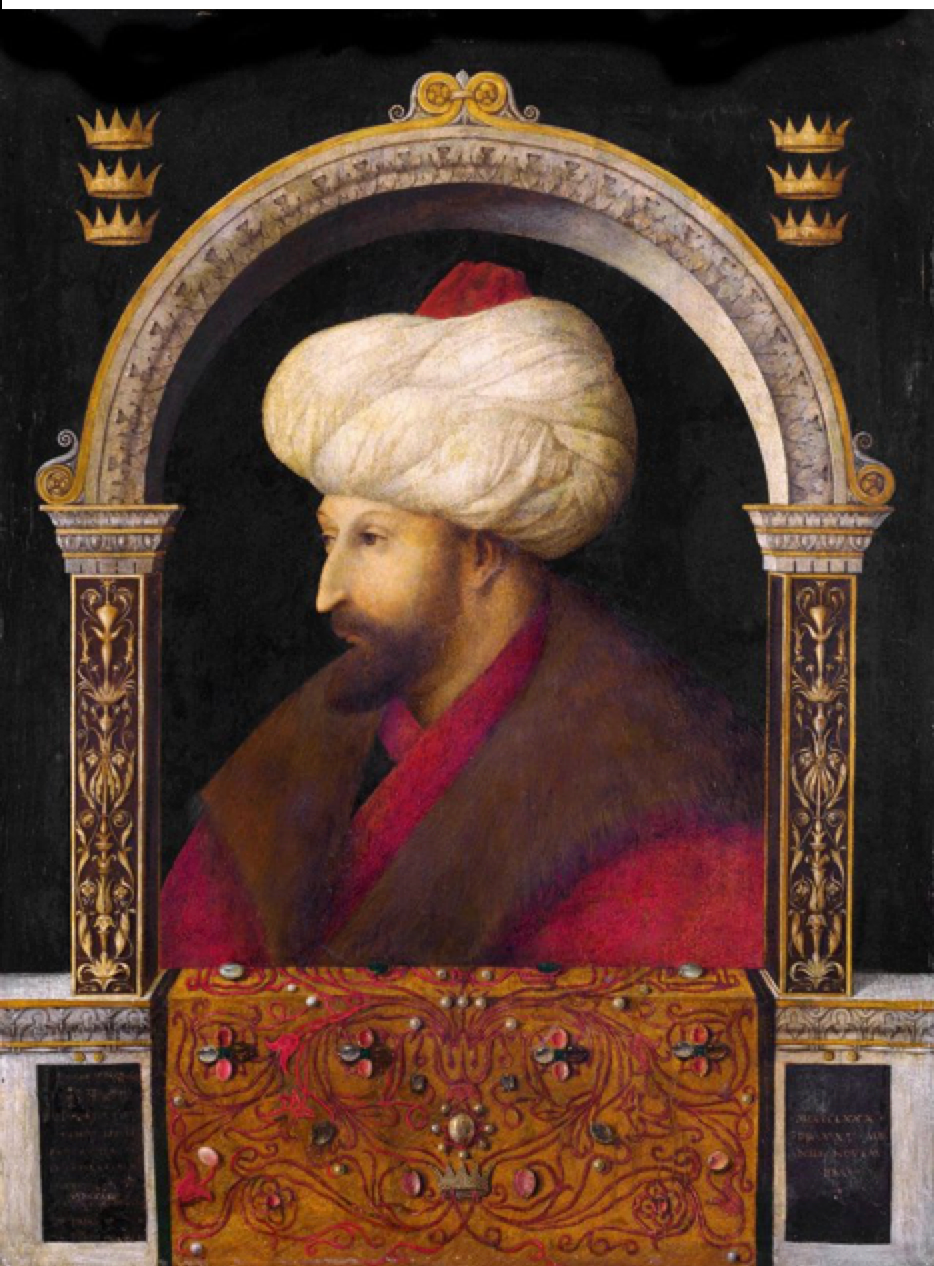
Mehmed II succeeded his father in 1451 at the age of 19 years old, as the 7th sultan of the Ottoman Empire (founded by Osman Bey in 1299 - Ottoman is the Latinzation. Translates to the House of Osman). He needed to immediately prove himself a strong enough leader to be able to hold the throne.
And you did that through conquest, to prove your strength, leadership skill and energy to grow the kingdom. Upon ascending the throne, he immediately started a program of building up the navy in preparation for a campaign of conquest in the west.


Comments