Lyceum & Book Club - Week 13 - The Schism of 1054
- Mar 19, 2022
- 8 min read
Updated: Apr 4, 2022
Starting with tonight's session, we will spend the next couple of weeks looking with what was happening in Constantinople up to the Fall of Constantinople in 1454.
We will then look at countries on the fringe of our interests, because they all play into the events leading up to and pushing The Reformation.
At that point, we are ready to zero in on The Habsburg Empire and then look at the context of the Netherlands in all of this before moving onto The Reformation.
--------------------------------------
We need to go back to the Roman Empire to understand what happened in the Great Schism of 1054. The Roman Empire had become too immense for one single ruler to govern effectively. In 285, long before Constantine moved the capital to Byzantine, Roman Emperor Diocletian divided the empire into two divisions - Western Roman Empire and Eastern Roman Empire (what would become the Byzantine Empire).
As you would expect, while the two halves worked together, slowly they started to drift apart.
For one thing, they spoke different languages. The main language in the west was Latin, while the main language in the East was Greek.
But they also had a different histories, they had different cultures. Rome had conquered the territories to the East, but the people of the East - Greek influenced for centuries, didn’t necessarily feel inferior to their overlords to the west and as events happened in the west, those in the East regained their sense of independence and identity. That is something that happens naturally. No people like to feel subjugated or inferior.
The fact the Western Roman Empire was over run by Germanic tribes from the north and was going through a transition with the destruction of its previous foundations, while the East was in a period of prosperity and expansion did not help to hold a united identity centered in Rome.
Those in the East did not have to look to the West to gauge how the power entities felt on an issue, they looked to the power center of the Roman Empire that was in their own backyard. So, there was a secular, political split of power in governing bodies first.
We have mentioned the five patriarchs of the Christian Church. These were bishops who had authority over all of the under bishops in their region. The patriarch of Rome started out as “first among equals”, not superior to the other Patriarchs of the Church. The patriarchs were in centered in the East, with Rome simply the furtherest western outpost.
Jerusalem, Constantinople, Antioch in Turkey, Alexandria in Egypt and also Rome.
Constantine the Great moved the capital of the Roman Empire to Constantinople in 330AD.
The first indication of a religious split came in 343. There was a theological split over the issue of Arianism - whether Jesus was equal to God and therefore divine. In the East, the idea that Jesus was not on a par with God was an accepted concept by many.
In the Western Church, Arianism was not ok. This issue festered between the two sides until 398.
Then there came a power issue in 404 and it involved the secular Emperor (who resided in the East), so we now have not only a question of who’s power out-trumps who’s power, but the state and church are getting entangled on who has power over local church issues.
And here is where we will begin to watch as the power struggles between east and west get started, a series of dominoes toppling, each incident building up resentment between the two sides.
Background:
John Chrysostom (347 - 407AD) was a prolific writer on theological topics and a gifted and popular speaker in the city of Antioch. He was someone who was viewed as speaking up against the tyranny of the powerful. The following incident illustrates his popularity among the masses and how much influence he had among the populace and why he might be viewed as a threat by the authorities.
From wiki:
When Chrysostom arrived in Antioch, Flavian, the bishop of the city, had to intervene with emperor Theodosius I on behalf of citizens who had gone on a rampage mutilating statues of the emperor and his family (because of the emperor's opposition to Chrysotom and his wanting to respond with punishment of the city and population).
During the weeks of Lent in 387, John preached more than twenty homilies in which he entreated the people to see the error of their ways (in reacting violently to the emperor in opposing himself). These made a lasting impression on the general population of the city: many pagans converted to Christianity as a result of the homilies. The city was ultimately spared from severe consequences.
An influential government player in the East nominated Chrysostom as patriarch of Constantinople, possibly as part of a power play against opposing political factions within the government. The patriarch/ Pope of Rome supported his nomination.
The Emperor of Byzantine, Arcadius, refused to accept Chrysostom as the Patriarch of Constantinople because he knew Chrysostom would be trouble (and he was right). The other four patriarchs in the East agreed with the Byzantine Emperor and also refused to accept Chrysostom as legitimate. So the Pope of Rome broke off all communication with the Eastern Churches. This lasted until 415 when the Eastern Patriarchs finally accepted the legitimacy of Chrysostom as Patriarch of Constantinople.
----------
At the First Council of Nicaea, a statement of the Church’s beliefs was produced and agreed to. This statement of belief is called the Nicene Creed.
That statement was updated a number of times, but in 431, at the Third Ecumenical Council, the council stated that no further additions would be allowed.
The Church out of Rome went ahead and added words anyway.
The original statement read:
“We believe in the Holy Spirit, the Lord, the giver of life, who proceeds from the Father”
Rome added the words - “and the Son”
“We believe in the Holy Spirit, the Lord, the giver of life, who proceeds from the Father and the Son.”
The Eastern Patriarchs said that was not canonical, meaning it was not according to accepted law in the church.
----------
In the middle of this infighting, the Germanic leader, Odoacer staged a revolt against the Emperor in Rome and forced him to step down in 476. The Western Roman Emperor, Romulus Augustus was only 16 at the time who had been installed by his father just 10 months before. This is considered when the Roman Empire is considered to have officially collapsed.
---------------
And then in 482, we have another split over theological issues. The Patriarch of Constantinople encouraged the Byzantine Emperor to issue an edict on the issue of whether Jesus was totally divine or whether he had two natures - a human side and a divine side, in order to reconcile the differences between the two sides of the church.
The Pope in Rome rejected the edict and excommunicated the Patriarch of Constantinople for arranging the whole affair in the first place.
This latest conflict lasted until 519, when Emperor Justin I recognized the excommunication of the Patriarch as legitimate and did not continue the battle to fight it.
---------
But the beliefs promoted by each side were drifting further apart and becoming entrenched as tradition.
----------
The eastern patriarchs believed in miaphysitism - the belief that Jesus’ human side and divine side were one and indivisible as well as indistinguishable from each other.
-------------
They disagreed over the Eucharist (the rite where bread and wine are used to symbolize Christ’s body). The Roman Catholic Church started using unleavened bread while the Eastern Orthodox Church did not. The Eastern Orthodox Church started dipping the bread in the wine, which the Roman Catholic Church thought was not right.
----------
And there were other issues, such as - who had jurisdiction over the Balkans? Each side felt they had jurisdiction.
-------------
And then there was the dispute over the Patriarch of Constantinople being named “ecumenical patriarch”. The Western Church felt it meant that calling the Patriarch of Constantinople the Ecumenical Patriarch was meant to indicate that the post was elevated to “universal patriarch over all”. And of course, it went the other way too. The Eastern patriarchs were all for the Pope having a higher position of honor than the other patriarchs, but not a higher authority than the Eastern patriarchs. They did not want the Pope of Rome telling them what to do in their churches.
---------------
So it was not just a matter of difference in beliefs and worship, it was also a matter of power.
Each time, the two sides reconciled for the good of the body of the Christian Church, but when a number of churches in Constantinople started using Roman Catholic practices, the Patriarch of Constantinople felt Rome was intruding directly upon his authority and taking his soul eggs.
He demanded they stop following Rome practices. The Pope in Rome had already given his approval before they ever embarked on this path, so the churches refused & denied his authority over them.
The Patriarch of Constantinople shut the churches down. He then sent a letter to the Pope condemning the practices they used in the Roman Catholic service.
The Pope then wrote a letter back refuting his points and declaring that the Pope in Rome had supremacy over the patriarchs in the Eastern Orthodox Church.
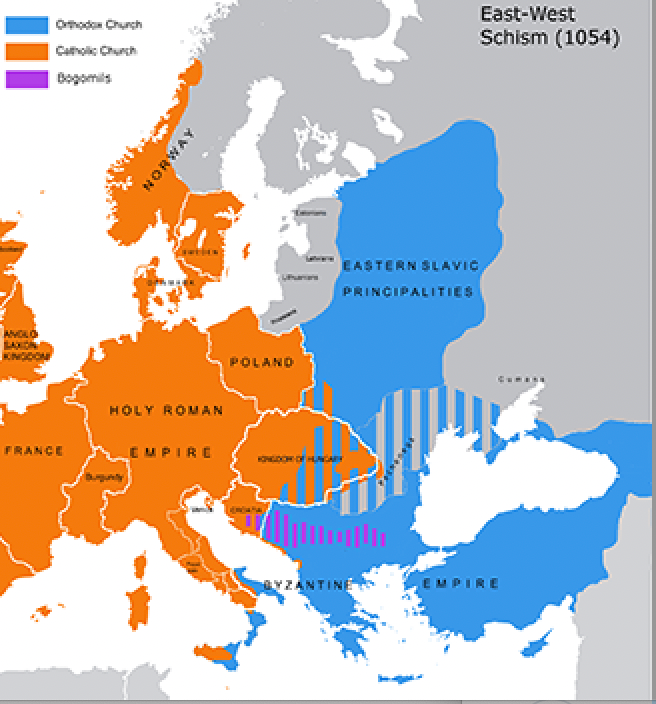
The delegation that carried the letter from the Pope to the Patriarch of Constantinople arrived in the year of 1054.
The Schism of 1054.
Apparently, the members of the delegation intended to make this a public battle and not leave it to be argued and worked out between the heads of the two factions. It seems they broke the seal on the letter and had the letter published to the general public in Constantinople. Which was not something you did with private affairs of church or state.
Upon their arrival in Constantinople, delegation felt they were not welcomed by the Patriarch of Constantinople with sufficient respect and they walked out of their meeting with the Patriarch as soon as they had handed over the letter from the Pope.
The Patriarch of Constantinople was livid. Especially when he realized what they had done breaking the seal on the letter and having it published. He ignored them as nonentities and refused to see them again.
They then marched into the Cathedral of Hagia Sophia, the main church of the Eastern Orthodox Church in Constantinople during mass and walked up to the altar and placed a new letter to the Patriarch on the altar before walking out again.
This letter declared that the Patriarch of Constantinople was excommunicated by the Pope.
The Patriarch burned the letter (called a Papal Bull).
--------------
The two sides still communicated, but it was strained. The final split came during the Fourth Crusade when Crusaders, encouraged by the Pope, sacked Constantinople and the Hagia Sophia.
And this was the first permanent split within the Christian Church into the Roman Catholic Church and the Eastern Orthodox Church.
In the Schism of 1054, both sides went over the cliff - each ordering the closure of any church in their territory that did not conform to their sides' practices. It got to the point where the heads of each church excommunicated members of the other side.
And in the middle of this competition was also the issue of the massacre of 1182 in Constantinople, when the Eastern Orthodox population of Constantinople massacred almost the entire Roman Catholic (referred to as Latin) population (that originated from Italy while the eastern orthodox were Greek).
And then you had resentment that went the other way when in 1204 Crusaders from the west (prompted by Venice) sacked Constantinople because it was seen as much of an enemy and foreign faith to be overcome and replaced as the Islamic faith in the Holy Lands was viewed.


Comments