Lyceum & Book Club - Week 13 - Lecture Notes on the Fourth Crusade
- Mar 19, 2022
- 10 min read
To understand where the schism of 1054 led to, we need to look at the Fourth Crusade.
In order to understand why Constantinople fell to the Ottoman Empire in 1453, we need to look at the why of the Fourth Crusade and its success in sacking Constantinople and how it set up the Byzantine Empire on its long downward tumble to the point the Ottomans were able to conquer the Byzantine Empire so easily in 1453..
By the 13th century,1,000 years after the original Byzantine Empire had been established (in 330 AD) by Emperor Constantine,Constantinople was having internal issues that created the conditions for her to be conquered by crusaders in 1204.
The Fourth Crusade, 1202 - 1204, was originally targeted at Egypt, thinking if the Crusaders conquered Egypt, which they viewed as weaker than Jerusalem, they would have a base from which they could consolidate and then attack and conquer Jerusalem and then the entire Holy Lands and beyond.
From world history.org:
The Third Crusade (1187-1192 CE), although achieving some notable military successes, had failed completely in its original objective of recapturing Jerusalem from the Muslim Sultan of Egypt and Syria, Saladin (r. 1174-1193 CE). The celebrated Sultan was now dead, but the Holy City remained in Muslim hands. Yet another crusade was required. The Fourth Crusade was thus called for by Pope Innocent III (r. 1198-1216 CE) in August 1198 CE.
The Pope's timing was not the best, especially considering the Holy City had anyway been in Muslim hands since 1187 CE. In the final years of the 12th century CE, all four monarchs of Europe's most powerful kingdoms, England, France, Germany, and Spain, were busy with internal affairs, and in the case of England and France, serious territorial squabbles with each other.
In the end, Venice (who was owed a huge sum of money by the enterprise of the Crusades for the year they had spent building ships and gathering supplies, etc for the contracted expedition and found the Crusaders had no means to pay them back, with the city now facing financial ruin as a result) and its allies (the family of the former emperor of Byzantine who had been deposed by his brother and who now wanted to reverse that event and promised payment if successfully undertaken (but had no means to actually pay back the owed sum) and the Crusaders (who fought for loot and land and in the name of the western Christian Church who wanted to reduce its competitor in the Christian realm) diverted the purpose and target of the Crusade to a new target and purpose - attacking and conquering Constantinople, the capital of Byzantine, the eastern Christian (Orthodox) empire.
Constantinople was in no condition to defend itself against the forces that accompanied the deposed emperor because he and his family had already bled the treasury and sold off its ships and weapons in order to enrich themselves for the moment.
From wiki:
Constantinople had been in existence for 874 years at the time of the Fourth Crusade and was the largest and most sophisticated city in Christendom.Almost alone amongst major medieval urban centres, it had retained the civic structures, public baths, forums, monuments, and aqueducts of classical Rome in working form. At its height, the city was home to an estimated population of about half a million people protected by thirteen miles of triple walls. Its planned location made Constantinople not only the capital of the surviving eastern part of the Roman Empire but also a commercial centre that dominated trade routes from the Mediterranean to the Black Sea, China, India and Persia. As a result, it was both a rival and a tempting target for the aggressive new states of the west, notably the Republic of Venice.
In 1195, the Byzantine Emperor Isaac II Angelos was deposed in favour of his brother by a palace coup. Ascending as Alexios III Angelos, the new emperor had his brother blinded (a traditional punishment for treason, considered more humane than execution) and exiled.
Ineffectual on the battlefield, Isaac had also proven to be an incompetent ruler who had let the treasury dwindle and outsourced the navy to the Venetians. His actions in wastefully distributing military weapons and supplies as gifts to his supporters had undermined the empire's defenses.
The new emperor was to prove no better. Anxious to shore up his position, Alexios bankrupted the treasury. His attempts to secure the support of semi-autonomous border commanders undermined central authority. He neglected his crucial responsibilities for defence and diplomacy. The emperor's chief admiral (his wife's brother-in-law), Michael Stryphnos, reportedly sold the fleet's equipment down to the very nails to enrich himself.
And when it looked like Constantinople would fall back into the hands of his brother whom he had deposed in a castle coup, what did Alexios III Angelos, the new emperor of Constantinople do? He stole the rest of the treasury and escaped, leaving the citizens to their fate, caused by his family’s greed for wealth and power.
———————————————
In the process of attacking and conquering Constantinople, the Crusaders destroyed a good portion of the city, looted its citizens, raped it’s women, killed innocents and plundered its churches - some historians of the time claimed it was worse than anything the Crusaders had yet done to the Muslims in the Holy Lands. (those Muslims would like to have a word)
Venice received as payment, ownership to several of the island territories and much of the riches and relics that were plundered. And of course, the Crusaders held back a share of the loot for their efforts.
A slaughter of the defenders and the city's some 400,000 inhabitants followed. Citizens were raped and massacred, buildings were torched, and churches desecrated. Three days of looting followed where artworks were destroyed, precious goods were melted down, and religious relics were taken back to Europe. - world history.org
It left Constantinople in a reduced condition.
The Fourth Crusade was the beginning of the end of the era of Crusades.
The video below does a good job of bringing us from the initial stage of the Fourth Crusade described above to the point where western European Crusaders take over Constantinople.
Fourth Crusade | 3 Minute History / Jazzy - 4.11 min
——————————————————————————
From 1204 to 1261,Constantinople was part of the Latin Empire of Constantinople (the term Latin refers to the western or Roman Catholic church) - conquered by western Crusaders who viewed the city's eastern orthodox orientation as heretical.
The Latin Empire of Constantinople was a feudal empire established by leaders of the Fourth Crusade who had sacked Constantinople in 1204. They divided church and civil governments (and the incomes they received from those entities) between the conquering Crusaders and their creditors in Venice,Italy. Those creditors in Venice got title to many of the Greek islands as their part of the deal for financing the venture.
The Latin Empire of Constantinople covered territory on both Greek and Turkey sides of the Straits of Dardanelles and the Sea of Marmara.
It's rulers also controlled the kingdom of Thessalonica, the principality of Achaia(the large southern island attached by a land causeway to the mainland of Greece) and other small kingdoms they had conquered.
——————————————————————————————
Let’s look a little closer at that division to orient ourselves where all the players stood at the end of the Fourth Crusade in 1204:

Venice acquired the island territories in dark blue, including Crete.
The Venetians took three-eighths of Constantinople, the Ionian islands, Crete, Euboea, Andros, Naxos, and a few strategic points along the coast of the Sea of Marmara. Thus, Venetian control of Mediterranean trade was now almost total. - world history.org
Count Baldwin of Flanders acquired the territories in purple.
Baldwin now became the emperor of the Latin Empire.
On 9 May 1204 CE, Count Baldwin of Flanders was made the first Latin Emperor of Constantinople (r. 1204-1205 CE) and crowned in the Hagia Sophia, receiving five-eighths of Constantinople and one-quarter of the Empire which included Thrace, northwest Asia Minor, and several Aegean islands. - world history.org
Boniface acquired the territory in black.
Boniface now became king of Thessalonica.
Boniface of Montferrat took over Thessalonica and formed a new kingdom there, which also included Athens and Macedonia. - worldhistory.org
Greece was divided up into a number of duchies, see gray area and bluish purple area on the bottom of the Greek peninsula. And a new duchy (in light blue) was created in the north.
William I Champlitte and Geoffrey I Villehardouin founded a Latin principality in the Peloponnese while the French duke Othon de la Roche grabbed Attica and Boeotia. - world history.org
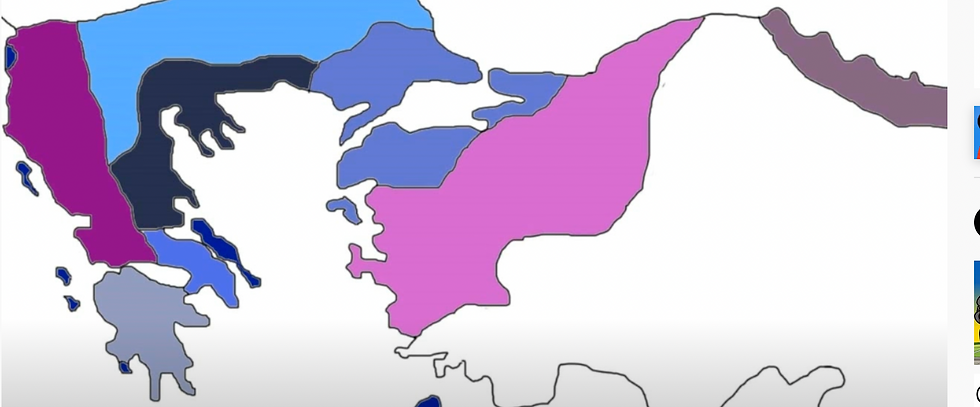
Only three empires were left being ruled by Greeks (Eastern Orthodox Christians as Constantinople/ the Byzantine Empire had been).
Dark violet - Despotate of Epirus
Light violet - the Empire of Nicaea
Dull violet (way to the east) - Empire of Thebizond
——————————————————————
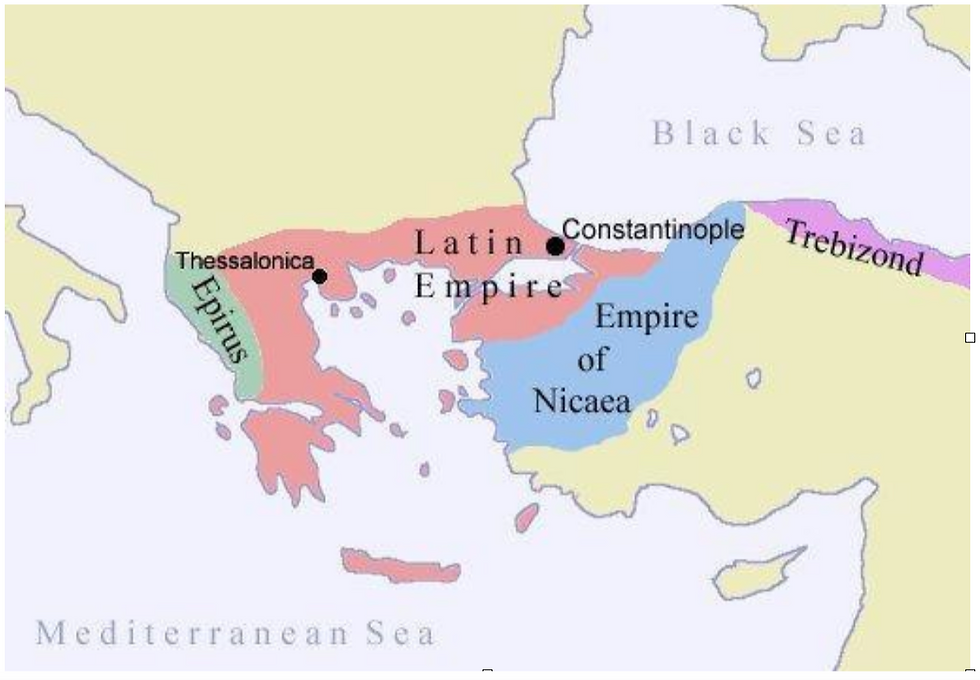
A clearer map showing the Western European rulers (pink) and the three Greek entities (green, blue and purple).
——————————————————————
In the period that the Crusaders ruled Constantinople and related territories,Constantinople was Roman Catholic until 1261 when the Greek ruled Eastern Orthodox states reconquered Constantinople.
The Crusaders took over Constantinople and most of its Byzantine territories, but that is all they cared about - the ownership and enrichment of themselves, not the people, not the city or Empire, nor the ideals it represented. They did not invest of themselves or their money to do more than what was necessary to keep themselves in power. The remaining original Byzantine Empire split into smaller holdings - Nicaea, Epirus and Trebizond. They each fought the crusaders to win back Constantinople and the conquered territory, but they also fought among themselves so that when they won back the conquered territory, it would be themselves who would be crowned Emperor of the Byzantine Empire. So that singular event of western Crusaders sacking Constantinople set into motion, from that point on, the splintering of the Byzantine Empire into competing statelets.At a time when the eastern frontlines of Christendom faced it's greatest threat, it was at its weakest point internally.
Even though the Niceans eventually won back Constantinople, they then faced the Latins, Serbians,Bulgarians and the Ottoman Turks.
——————————————————————
Let’s look at the main players who took over Constantinople and the Byzantine Empire, renaming it the “Latin Empire”.
From world history.org:
Unlike the previous Crusade, then, this was not to be a “Kings' Crusade”. Still, a good number of second-tier nobles were inspired to join up or 'take the cross', as it was known, especially from northern France
Baldwin (the first) was a count in Flanders when he went on the Fourth Crusade. Many of the leaders of the crusades were second sons who went on crusades with the (added) incentive of gaining their own kingdoms (and additional income from those territories). The other leaders of the Fourth Crusade elected Baldwin as the Emperor of the Latin Empire of Constantinople upon their capturing of the city and surrounding area in 1204. In 1205, he was captured in battle by the Bulgarians and died (by poison, it is said).
His brother,Henry of Flanders succeeded him as Emperor of the Latin Empire of Constantinople. He lasted until 1216 and is said to have been the most able of the Latin Emperors. He fought off the Bulgarians and Emperor Theodore I of Nicaea.
Henry's brother-in-law,Peter of Courtenay of France (and his wife) succeeded Henry. But on his way to assume his throne,Peter was captured by Theodore (Despot of Epirus) and died (probably not naturally) in captivity.
So Peter's son, Robert, became the Emperor of the Latin Empire of Constantinople.
In 1224,Robert was defeated by both Theodore,Despot of Epirus and John III of Nicaea and lost large areas of territory in the Latin Empire as a result. The territory of the Latin Empire of Constantinople shrunk to pretty much just the city of Constantinople.
In 1228,Robert was deposed and his younger brother, Baldwin II, was placed upon the throne with a regent to rule in his stead until he reached an age to take over.
That regent was John of Brienne, a French count.
Now here it gets a little more interesting, so let's take a look at John of Brienne from France, who took over the rulership of The Latin Empire of Constantinople. (technically,John was merely the regent for Robert's brother,Baldwin II, until Baldwin II came of age)
John of Brienne went on the Fifth Crusade to the Holy Lands and married the titular queen of Jerusalem in 1210. She died two years later, in the same year their daughter was born. So John was regent for his daughter as Queen of Jerusalem - but in actuality, he was the ruler. He went to Europe seeking financial and military support and arranged the marriage of his daughter,Queen of Jerusalem, to Holy Roman Emperor Frederick II. Where upon Frederick immediately claimed the throne of Jerusalem for himself. In response,John of Brienne joined the papal army and they invaded Fredrick's kingdom while Frederick was out on crusade to the Holy Lands (1229).
Lo and behold, it turns out that soon after this failed marriage arrangement,John Brienne arranged the marriage of his daughter to Baldwin II of Constantinople, so John Brienne not only acted as regent for Baldwin II and ruled in his stead - he was now Baldwin II's father in-law.
Four years after John was named regent for Baldwin II, he became co-emperor of the Latin Empire of Constantinople along with Baldwin II (1231).John successfully defended Constantinople against attack by the combined forces of Emperor John III of Nicaea and Czar Ivan II of Bulgaria in 1236.
Baldwin II was the last emperor of the Latin Empire of Constantinople.
Baldwin only gained control over his own throne when John Brienne died in 1237, but by this time the Latin Empire of Constantinople was just hanging on by a thread. Baldwin spent a good part of his time fundraising in Western Europe to keep Constantinople going. So financially desperate was he, that it is said he sold sacred relics (like part of the True Cross) to Louis IX of France and is said to have even pawned his own son to creditors in Venice at one point.
When Michael VIII of Nicaea stormed Constantinople in 1261,Baldwin II escaped to Italy and transferred his title to the throne to Charles I of Naples (I'm sure for a tidy sum).
And thus it goes until we get to 1453 and the Ottomans.
——————————————————————
Let’s now look at the events:
As so often happens, conquering a territory is the high point of the venture and often the easiest part. Holding onto that territory and making a go of it is a little harder. Almost immediately upon conquering Constantinople - things started falling apart.
Basically - everyone started attacking them
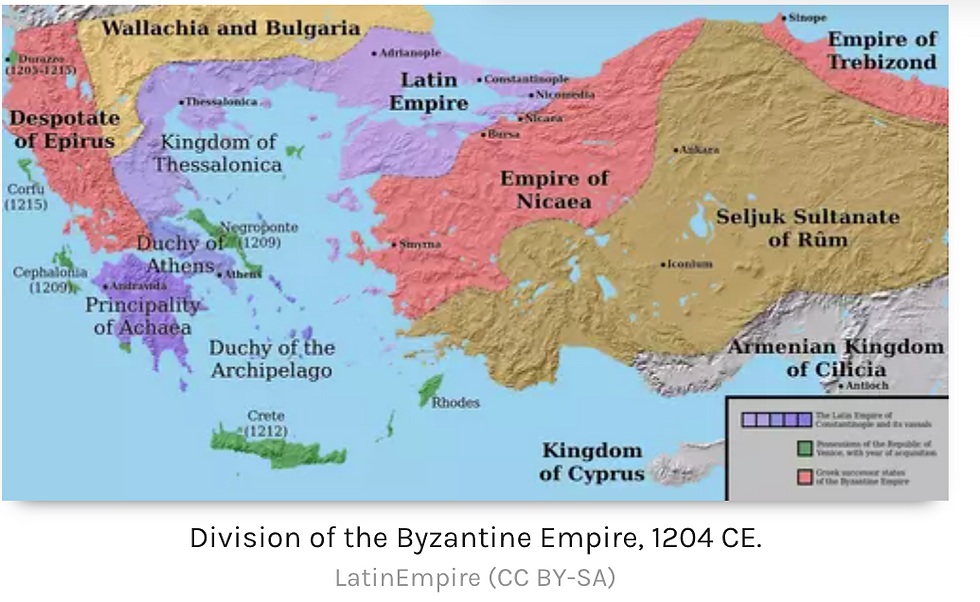
The Empire of Nicaea, the Despotate of Epirus and the Kingdom of Trbizond were the remaining remnants of the Byzantine Empire after the Crusaders conquered the other parts of the Empire. The Greek rulers of the Empire of Nicaea (in Turkey) and the Greek Empire (Despotate) of Epirus attacked the Latin Empire trying to regain the Empire.
The Bulgars under Ivan II (Bulgaria - north of the Latin Empire in the Balkan region) saw an opportunity to extend his reach as did the Turks.
All of these entities started attacking the Latin Empire of Constantinople.
In addition to the outside assaults, the local Greek population within the Latin Empire did not willingly go along with the plans of their new conquering leaders from rival Roman Catholic west.
Plus there were disputes among the Crusade leaders.
And thus started the dissolution of the Latin Empire of Constantinople almost as soon as it had been formed.
1204 - Leaders of the Fourth Crusade conquered Constantinople
1222 - The kingdom of Thessalonica was reconquered by the Despot of Epirus.
1224 - Emperor John III of Nicea reconquered territory in the Asia Minor (Turkey) section of the Latin Empire.(John III - ruled Nicea from 1222-1254)
1234 - Constantinople almost fell to the Bulgars under Ivan II
1261 - only to fall to Emperor Michael VIII of Nicea, which ended the Latin Empire of Constantinople and started a new chapter with a new owner of the city of Constantinople(Michael VIII co-ruled Nicea from 1259-1261 when the Byzantine Empire was restored)


Comments