Lyceum B - Astronomy - Week 36 - Comets
- Aug 21, 2022
- 3 min read

Comets
Millions of comets also orbit the Sun. Comets are sometimes called “dirty snowballs” because they are made up of dust, rock and ice that was left over from the formation of the Solar System.
Comets originate in the Kuiper belt or the even more distant Oort Cloud. If they fall into the Solar System, they get trapped by the gravity of the Sun into an orbit.
From wiki:
Comets usually have highly eccentric elliptical orbits, and they have a wide range of orbital periods, ranging from several years to potentially several millions of years. Short-period comets originate in the Kuiper belt or its associated scattered disc, which lie beyond the orbit of Neptune. Long-period comets are thought to originate in the Oort cloud, a spherical cloud of icy bodies extending from outside the Kuiper belt to halfway to the nearest star.
Comets are distinguished from asteroids by the presence of an extended, gravitationally unbound atmosphere surrounding their central nucleus.
They range in size from a few miles across to tens of miles wide.
When a comet’s orbit brings it close to the Sun, it heats up and begins to rapidly release an enormous head of steam and sometimes a long tail of dust and glowing gases. The process is called outgassing. The tail can stretch away from the Sun for millions of miles.
From How the Universe Works:
A comet’s tail always points away from the Sun because it is blown back by the force of the solar wind - a stream of high-speed particles blowing away from the outer layers of the Sun. Thus, when a comet is traveling away from the Sun, it appears to be going backwards.
Once comets enter an orbit around the Sun they are thought to last only a few hundred-thousand years.
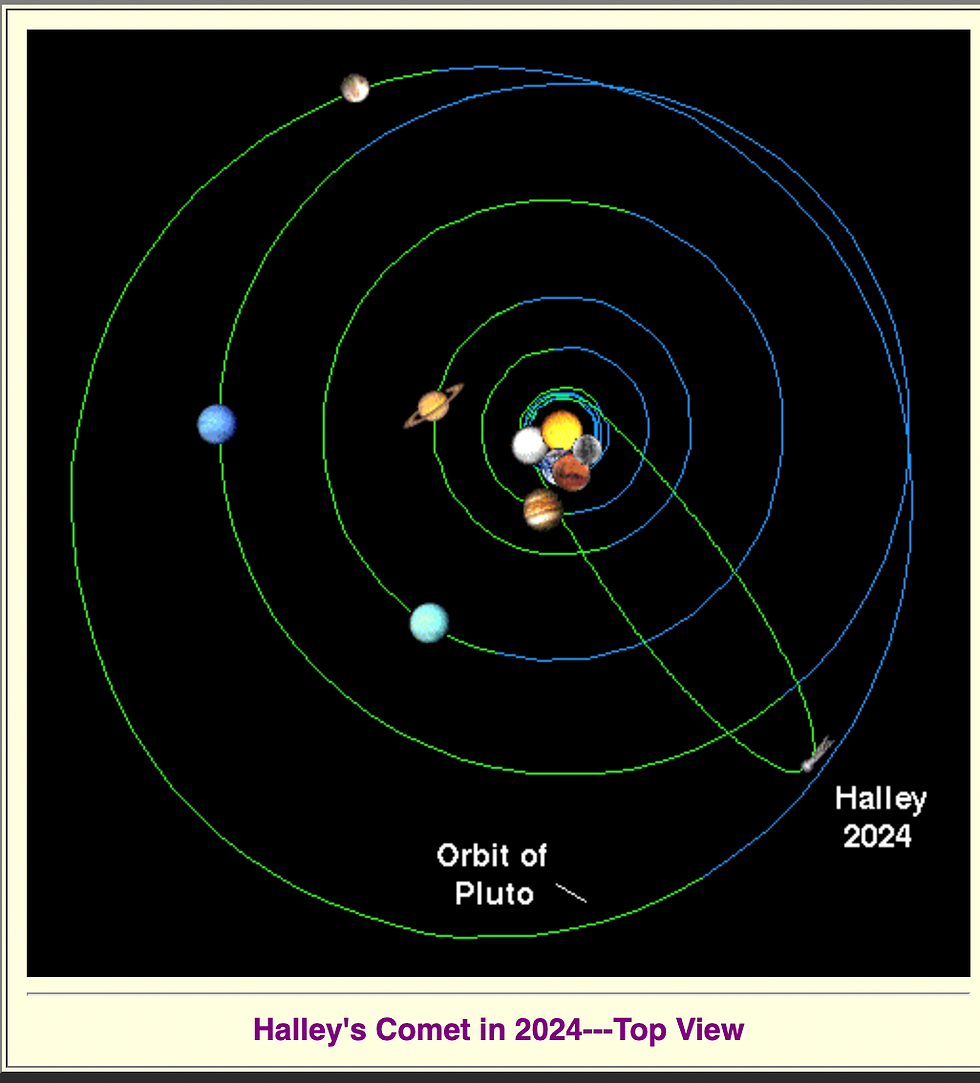
Most comets have long, narrow orbits. As they come close to the Sun, they speed up in order to avoid being pulled into the Sun by its strong gravitational force. As they reach their farthest point in their orbit away from the Sun, they slow down because they are only weakly effected by the pull of the Sun’s gravitational force.
The most famous comet that can be seen from Earth is Haley’s Comet.
Edmond Halley was an astronomer and physicist. In 1705, he made the prediction that a comet that had passed the Earth in 1683 would do so again in 1758. He was right and so the comet was named in his honor. Halley’s comet passed by the Earth in 1986. It will pass by the Earth in 2062 (but that will take place too far away for most people on Earth to see it) and again in 2134.
In 1986, the space p robe, Giotto passed by Halley’s Comet close enough to photograph the nucleus under the steam that surrounds the head. It found that the icy core of the comet is surrounded by some of the darkest material in the Solar System.
From wiki:
Halley's Comet or Comet Halley, officially designated 1P/Halley, is a short-period comet visible from Earth every 75–79 years.Halley is the only known short-period comet that is regularly visible to the naked eye from Earth, and thus the only naked-eye comet that can appear twice in a human lifetime. Halley last appeared in the inner parts of the Solar System in 1986 and will next appear in mid-2061.
During its 1986 visit to the inner Solar System, Halley's Comet became the first comet to be observed in detail by spacecraft, providing the first observational data on the structure of a comet nucleus and the mechanism of coma and tail formation. These observations supported a number of longstanding hypotheses about comet construction, particularly Fred Whipple's "dirty snowball" model, which correctly predicted that Halley would be composed of a mixture of volatile ices—such as water, carbon dioxide, ammonia, and dust. The missions also provided data that substantially reformed and reconfigured these ideas; for instance, it is now understood that the surface of Halley is largely composed of dusty, non-volatile materials, and that only a small portion of it is icy.
In 2004, the lander module of the European space probe, Rosetta, landed on a comet. Unfortunately, its battery power ran out within two days.
The best time to watch for comets is before sunrise to the east and after sunset to the west.


------------------------
Videos:
Professor Dave Explains
Dark Matter and Dark Energy: The Frontier of Astronomy - 11:54 min
Crash Course Astronomy #26 - Stars - 10:40 min


Comments