Lyceum B - Astronomy - Week 32 - Neptune
- Jun 15, 2022
- 2 min read
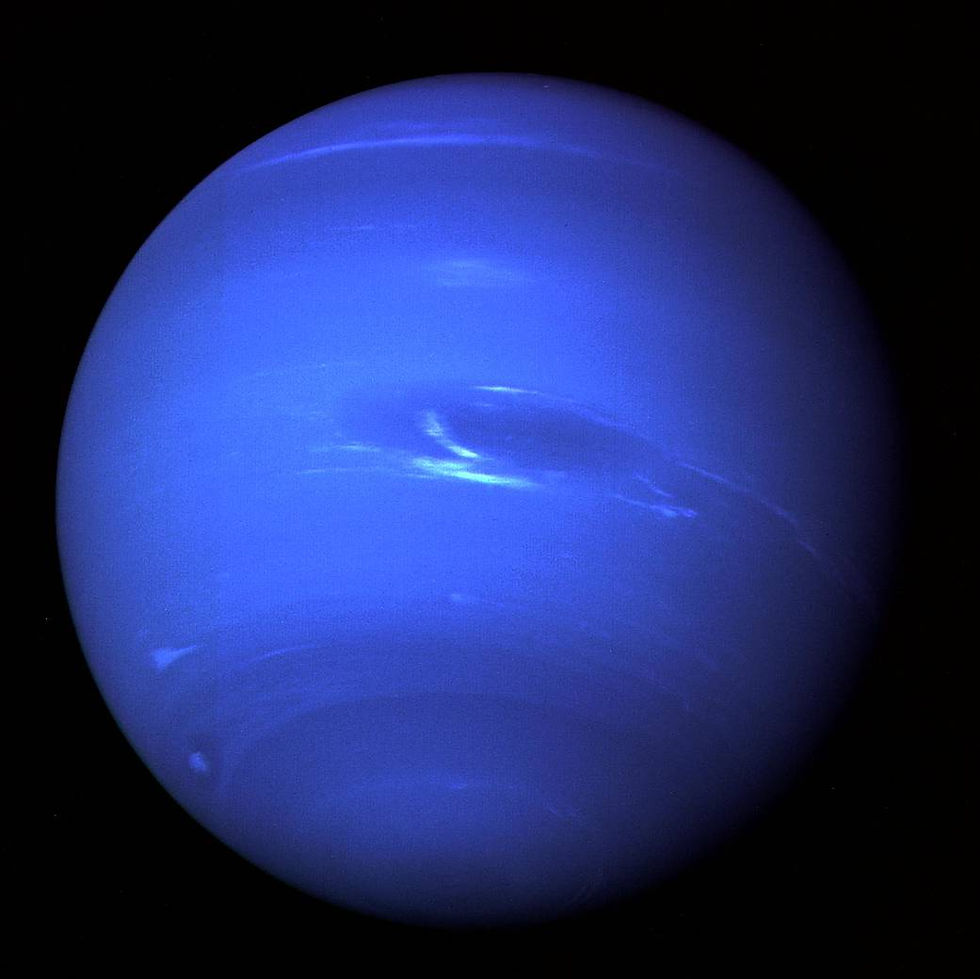

Neptune is the fourth and last of the gas giants and the eighth planet from the Sun.
In observing Uranus, astronomers noticed that sometimes Uranus wobbled in its orbit around the Sun, as though it was being pulled toward the edge of the solar system by the gravitational force of some other astronomical object out toward the edge. They speculated that this must be another planet and started looking mathematically where such a strong gravitational pull would come from. They came upon Neptune in 1846. Neptune can only be seen by telescope.
Up until 1989, Uranus and Neptune were always thought to be almost duplicates in character and were referred to as the "twin planets".
Voyager 2 sent back photos of Neptune in 1989, sending pictures of its rings and moons and analyzing its atmosphere.
While it appears greenish when viewed from Earth, the photos the Voyager sent back show it to be a bluish planet.
Neptune has four dim rings of unknown structure.
One of its moons, called Triton, is the coldest place in the Solar System. Its "air" is composed of nitrogen which freezes on the surface as solid ice without ever becoming liquid as part of the process because of the extreme cold temperatures.

Neptune is a frozen and stormy planet with ever changing weather planets, with violent winds rolling across its clouds.
Two prominent features of Neptune is a large dark oval which is a giant storm called the Great Dark Spot that is blown across the planet's surface by strong winds that blow in the opposite direction of the planet's rotation with the Dark Spot lagging just behind. And a small white spot called the Scooter, which is at a fixed location.
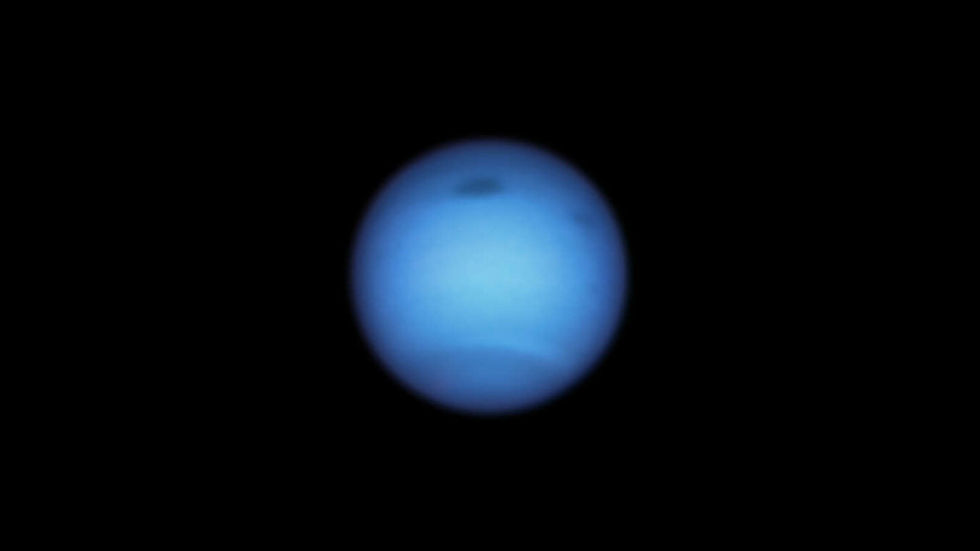

From wiki:
Like Jupiter's spot, Great Dark Spots are anticyclonic storms. However, their interiors are relatively cloud-free, and unlike Jupiter's spot, which has lasted for hundred's of years, their lifetimes appear to be shorter, forming and dissipating once every few years or so. Based on observations taken with Voyager 2 and since then with the Hubble Space Telescope, Neptune appears to spend somewhat more than half its time with a Great Dark Spot.
From Hubbsite.org:
This Hubble Space Telescope snapshot of the dynamic blue-green planet Neptune reveals a monstrous dark storm. The giant vortex, which is wider than the Atlantic Ocean, was traveling south toward certain doom by atmospheric forces at the equator when it suddenly made a U-turn and began drifting back northward.
Its interior is warmer than that of Uranus.
Neptune Facts: The Big Blue Planet [Infographic]

Videos
Professor Dave Explains
Pluto, Comets, Asteroids, and the Kuiper Belt - 10.39 min
Crash Course Astronomy #22
The Oort Cloud - 11:40 min


Comments