Lyceum B - Astronomy - Week 19 - The Sun
- Apr 6, 2022
- 4 min read
Updated: Apr 7, 2022
The Spectrum of the Sun (and other stars)
From How the Universe Works:
Light radiating out from the sun and stars can be split up with a prism, giving a rainbow of colors, its spectrum, corresponding to light of different energies. This spectrum, which is unique to each star, can reveal its temperature and composition.
Sun’s white light can be split up into its component colors, its spectrum, in many different ways. Sunlight is split as it travels in and out of transparent material, such as water or glass, and also when it is reflected off a finely ruled surface. There are many ways to view a spectrum: through a plastic ruler, on a rainbow, in water mist, or on dewdrops. This experiment will show you yet another way.
Making a Spectrum
You will need a flash light, a small mirror, white poster board, plastic putty or clay that can hold the mirror at and angle toward the poster board in a bowl of water so there mirror does not fall down.
Stand the poster board up next to the bowl of water.
Shine the flashlight straight down on the mirror. Adjust the flashlight until you see the spectrum on the white poster board.
How a Spectrum is Produced
White light is bent (refracted) as it passes into a glass prism and bent again as it emerges. The shortest wavelength of light (violet) is bent most, and the longest wavelength (red) least. So the light emerges from the prism fanned out into its component colors. White light is produced by hot objects that are solid or very dense, such as the soot particles on a candle flame or the dense gas in the Sun’s surface. The rapidly moving atoms in these hot bodies generate light of all wavelengths. But atoms in a thin gas emit or absorb light only at a few very definite wavelengths. Each kind of atom, or element, has a different arrangement of electrons orbiting a small central nucleus. As an electron jumps from a beam of white light, the result is a dark absorption line (named Fraunhofer lines) named at a wavelength corresponding to this energy. When the electron jumps down again, it emits light at this particular wavelength.
Pure white light - light from a hot solid object consists of all wavelengths. Its spectrum is a continuous “rainbow” containing all colors. The dense gas at the sun’s surface emits light just like a hot solid. If we could observe sunlight at the sun’s surface, it would form a continuous spectrum like this.


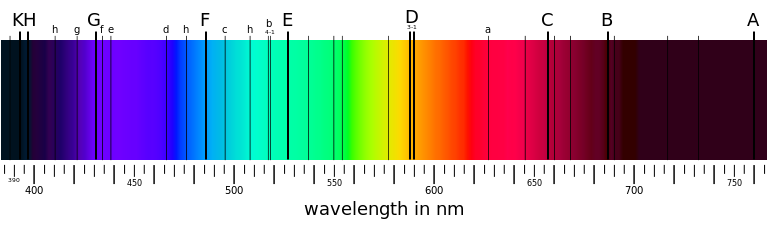
Sunlight - These lines are caused by cooler atoms above the sun’s surface absorbing light at particular wavelengths.
When scientists study the Fraunhofer lines of sunlight, they can detects that it contains the same Fraunhofer line pattern as hydrogen light and sodium light, so they know two components of the sun are hydrogen and sodium.
Hydrogen light - hydrogen atoms absorb light of several wavelengths.

Sodium light - when white light passes through sodium atoms, they absorb light only in the yellowest part of the spectrum. A sensitive spectroscope shows that this dark line is actually double. It is caused by atoms jumping up to two very similar orbits. When sodium atoms are heated, they emit bright yellow light consisting of these two wavelengths.

200 Years of Fraunhofer Lines
——————————————————
Making Fraunhofer Lines:
An instrument called a spectroscope produces a very detailed spectrum in which you can see all of the details, including the bright and dark lines that are the “fingerprints” of elements.
You will need a magnifying glass, white pasteboard, a candle , foam board
Cut a rectangular slit 6 x 1 inch out of foam board. Use a bit of clay or putty to hold the board upright.
Place the white poster board as the screen 20 inches away from the foam board.
Place a candle behind the opening in the foam board so just the light comes through the opening to shine upon the screen poster board. Light the candle. Hold the magnifying glass in front of the foam board and angle it to focus light from the candle onto the screen.
Now move the magnifying glass toward the screen until you can see an image of the opening in the foam board. Adjust the screen to focus and make the image sharp.
Hold a prism in front of the prism so the magnifying glass is focusing the light beam through the prism. Turn the prism until you get aq sharp spectrum on the screen. Now look from the position of the spectrum on the screen into the prism, moving your head from side to side. How many colors can you see?

To now look at the spectrum of sodium (table salt), use the same set up as below, but replace the candle with a lit camp stove and drop a pinch of salt into the flame. It will make a bright orange-yellow color. Now look into the prism. What colors do you see on the screen?
For a much more complex spectroscope you can make:
-------------------------------------------------------
Videos
Professor Dave Explains - - 11:48 min
The Formation of the Solar System and the Structure of the Sun
Introduction to the Solar System: Crash Course Astronomy #9 - 10:16 min


Comments