Lyceum A - Physics - Week 18 - Introduction to Simple Machines
- Apr 4, 2022
- 4 min read
Updated: Aug 24, 2022
From this point on, these lessons will be using the book “The Way Things Work” by David Macaulay on simple machines.
You will need to purchase the book - “The Way Things Work" by David Macaulay (you can get an older used copy for less money or buy the newest edition,”The Way Things Work Now”, which is more relevant in its topic choice, but either way, the topics we will read in class are covered in both editions, which edition you buy depends upon your own needs). We will assign pages to be read during class time.
From wiki:
The Way Things Work is a 1988 children's book by David Macaulay with technical text by Neil Ardley. It is an entertaining introduction to everyday machines, describing machines as simple as levers and gears and as complicated as radio telescopes and automatic transmissions. Every page consists primarily of one or more large diagrams describing the operation of the relevant machine. These diagrams are informative but playful, in that most show the machines operated, used upon, or represented by woolly mammoths, and are accompanied by anecdotes of the mammoths' (fictive) role in the operation. The book's concept was later developed into a short-lived animated TV show (produced by Millimages and distributed by Schlessinger Media), a Dorling Kindersley interactive CD-ROM (including a spin-off pinball game), and a board game.
A substantially revised edition, The Way Things Work Now, has been published in October 2016 by Houghton Mifflin Harcourt and Dorling Kindersley.
You will find this a useful reference book for the home long after you finish the year.
Note - we have both the board game and CD-ROM which members are welcome to check out (in their imagination) for a week at a time.
——————-
Tools and machines help us accomplish tasks that is we did not have the tools and machines, we would have to expend energy in working to accomplish the same task using only our body.
Simple machine, any of several devices with few or no moving parts that are used to modify motion and the magnitude of a force in order to perform work. They are the simplest mechanisms known that can use leverage (or mechanical advantage) to increase force. The simple machines are the inclined plane, lever, wedge, wheel and axle, pulley and screw. - Brittanica
What is a Simple Machine? - 2:37 min
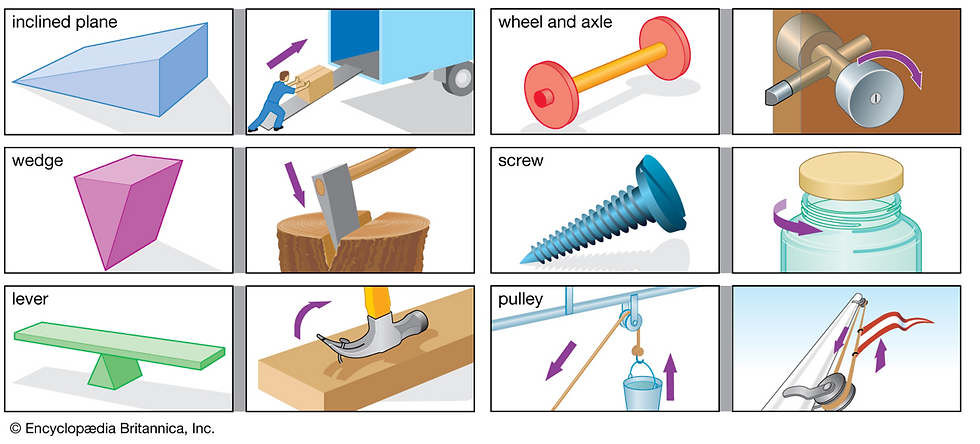
Here are some of the basic tools we use:
Incline Plane
An incline plane is a flat surface that is leaning between two surfaces at different heights to connect them.
If you had to go up a straight tall structure, it would take a lot of work to climb up there. But leaning a board at an angle from the ground to the top makes it a lot easier to walk up to the top.
If a person had trouble walking up steps or was in a wheelchair, an inclined ramp rather than steps makes the task much easier or possible at all. Same with slanted inclines of concrete or metal on curbs. What might have been a difficult or impossible task is suddenly made easier with a simple basic tool of an incline plane.
Pulley
It is much easier to exert force to pull down rather than to go against gravity and push an object up to a higher level.
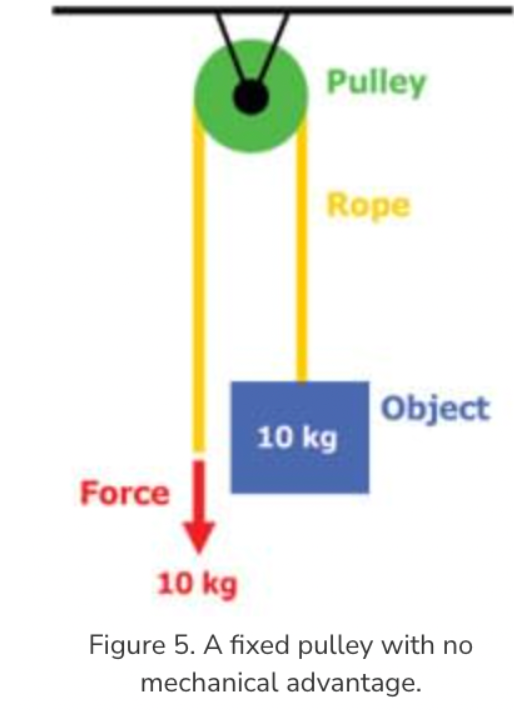
A pulley operates by a rope passing over a wheel (or wheels) on a Frame overhead (the wheel eases the motion of the rope passing overhead so there is less friction), with one end tied around the object you want to lift up to a higher elevation and the other end pulled in a downward motion by a person (or animal or vehicle). You pull down on the rope at one end and the object at the other end of the rope is raised.

Venetian blinds are one example of a device operated by a pulley.
Shows various types of pulleys in use:
Lever
A lever consists of a beam or fixed rod set on a point (called a fulcrum) somewhere along that beam in which you can push down on one end of the beam and it moves the other end of the beam up. It requires less energy to push down on a lever than it does to push the same object up with no lever.
A see saw is a good example of a lever in action.

A lever is a simple machine made of a rigid beam and a fulcrum. The effort (input force) and load (output force) are applied to either end of the beam. The fulcrum is the point on which the beam pivots. When an effort is applied to one end of the lever, a load is applied at the other end of the lever. This will move a mass upward. Levers rely on torque for their operation. Torque is the amount of force required to cause an object to rotate around its axis (or pivot point). - lets talk science.ca
The Mighty Mathematics of the Lever - TedEd - Andy Peterson and Zack Patterson - 4:41 min
Wedge
A wedge is a V shaped piece of wood or metal that can be used to create a split in another object and push the object into two separate sections.
Simple Machines: The Wedge - funsciencedemos - 7:00min
Screw
You can think of a screw as an incline plane that wraps around a pole. It makes it easier to make an object go up or down. An example is a swivel chair.
A screw is also more secure in any position than a pole with straight sides.
For example - a nail is easier to pull out of wood than a screw. A jar with a screw top is more secure than a jar with smooth sides to the lid.
What is a Screw? (With Narration) Simple Machines - Science for Kids | Educational Videos by Mocomi - MocomiKids - 1:48 min
Simple Machines (Screw) - Distance Learning Science Educational Video for Elementary Students & Kids - Bow Tie Guy and Wife - 1.37 min
Wheel and Axle
A wheel and axle consist of a rod (the axle) that goes through the center of a wheel allowing it to turn easily with less friction. The wheel is one of the most important inventions in the history of mankind.
Wheel and Axle - Simple Machines | Science for Kids | Educational Videos by Mocomi -MocomiKids - 1:41 min


Comments