Lyceum A - Physics - Week 15 - Friction
- Mar 21, 2022
- 4 min read
Gravity
Gravity is the phenomenon by which anything with mass is pulled toward one another.
On Earth, gravity gives weight to physical objects as everything is pulled toward the center of earth. The sun’s gravitational pull on the earth and all of the planets that orbit the sun is what keeps those planets in their position in space.
Ocean tides on earth are caused by the gravitational pull of the moon.
Sir Isaac Newton was the first person to mathematically describe what gravity is. His theory is called Newton’s law of universal gravitation. Albert Einstein made improvements on this theory with his theory of relativity.
Weight
Weight is the force of gravity on an object.
Our weight on Earth is how much force the Earth’s gravity has on us and how hard it is pulling us toward the surface. - ducksters.com
Mars is smaller than Earth with less mass, so it has less gravity. If you weighed 100 pounds on Earth, you would weigh only 38 pounds on Mars.
Galileo demonstrated that if you drop two objects of different masses from a height, they will both fall to earth at the same speed and so hit the ground at the same time.
Friction
Friction is the resistance to motion of one object moving across another object.
Science Max | Friction | Season 1 Full Episode | Kids Science - 22:02 min
To reduce friction in machines, we use things like rollers and lubricants which makes the operation move smoother.
Force
Force is the push or pull on an object. A force can cause an object to accelerate, slow down, remain in place, or change shape. - ducksters.com
Below are examples of force

Inertia:
Inertia is the resistance of any physical object to any change in its velocity. This includes changes to the object’s speed or direction of motion. An aspect of this property is the tendency of objects to keep moving in a straight line at a constant speed, when no forces act upon them. - wiki
Inertia | Forces and Motion | Physics | FuseSchool - 4:20 min
Speed and Velocity
Speed measures how fast an object is moving. It is the rate at which an object covers distance.
Velocity is the rate at which an object changes its position.
Speed refers to the time rate at which an object moves along a path whereas the rate and direction of that object’s movement will be velocity. - toppr.com
From physicsclassroom.com
Imagine a person moving rapidly - one step forward and one step back - always returning to the original starting position. While this might result in a frenzy of activity, it would result in a zero velocity. Because the person always returns to the original position, the motion would never result in a change of position. Since velocity is defined as the rate at which the position changes, this motion results in zero velocity. If a person in motion wishes to maximize their velocity, then that person must make every effort to maximize the amount that they are displaced from their original position. Every step must go into moving that person further from where he or she started.
Velocity is direction aware. When evaluating the velocity of an object, one must keep track of direction. It would not be enough to say that an object has a velocity of 55 mi/hr. One must include direction information in order to fully describe the velocity of the object. For instance, you must describe an object’s velocity as being 55 mi/hr, east. This is one of the essential differences between speed and velocity. Speed is a scalar quantity and does not keep track of direction; velocity is a vector quantity and is direction aware.
The Difference Between Speed & Velocity - 2:27 min
Acceleration
Acceleration is the rate of change in an object’s velocity. When you press down on the gas pedal in a car, the car surges forward going faster and faster. This change in velocity is acceleration.
Acceleration - 2:11 min
Acceleration - 9:06 min
From Khan Academy:
Newton’s 3 (three) Laws of Motion - makemegenius- 6:21min
Newton’s First Law of Motion
An object that is sitting at rest will stay at rest, and an object that is in motion will stay in motion until a force acts upon it.
Newton’s First Law of Motion Introduction
Newton’s Second Law of Motion
F=ma: The greater the force the greater the acceleration. The greater the mass, the greater the force needed to move the object.
Newtons Second Law of Motion - 7:14 min
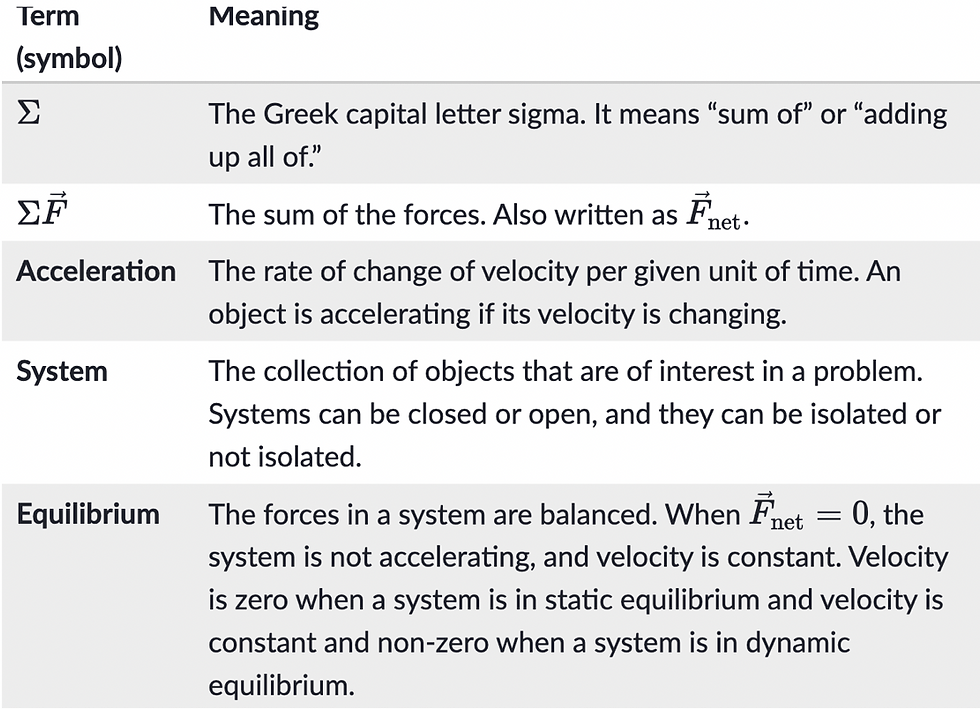
Newton’s second law says that the acceleration and net external force are directly proportional, and there is an inversely proportional relationship between acceleration and mass. For example, a large force on a tiny object gives it a huge acceleration, but a small force on a huge object gives it very little acceleration. Also, force and acceleration are in the same direction. - Khan Academy
From Khan Academy:
What else should I know about Newton’s second law of motion?
Balanced forces can cause the net force of an object to be zero. Multiple forces can act on an object. If the forces are balanced, the net force is zero and the object’s acceleration is also zero.
There are limitations to Newton’s laws. Newton’s laws are excellent for modeling our experience of the world. When we start investigating objects that are approaching the speed of light or are on the atomic scale, Newton’s laws are no longer accurate. Physicists have had to come up with additional models for these situations.]
Newton’s Third Law of Motion
For every action there is an equal and opposite reaction.
Forces are always found in pairs. If the forces are equal in opposite directions, the object will not move. The forces cancel each other out so that the acceleration is zero.
Newton’s Third Law of Motion - 8:00min
Videos


Comments