Friday Night Movie - Week 2 - Hand out for Background Information on Greece & Surrounding Region
- Mar 9, 2022
- 6 min read
Mesopotamia,Egypt and the Mediterranean World from 3,500 to 330 BC
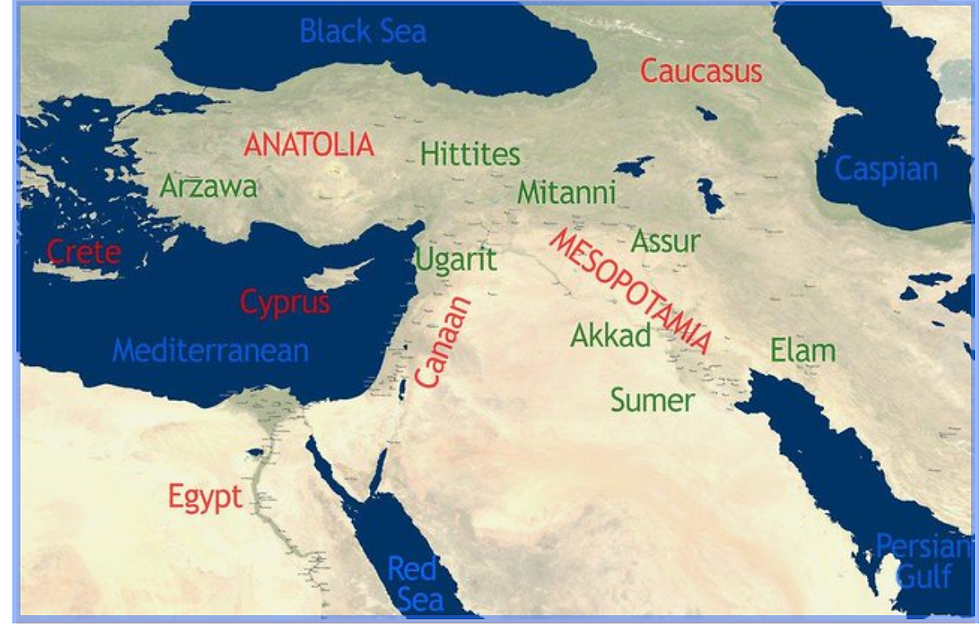
Mesopotamia and the Near East,3500 - 1600BC
The first uniting of an empire in the Mesopotamia region came under Sargon when he brought all of the old Sumerian city-states under his central control. He and his successor then started conquering territory from southwest Iran to Syria. One of his motivators was a desire to try and extend trade (routes).
"By the seventeenth centuryBC a new power centre was developing further north, in Anatolia, where the Hittites set up a kingdom. After 1650BC they began to spread southwards and in 1595BC they sacked Babylon. In the dislocation which ensued, the first Babylonian dynasty collapsed.
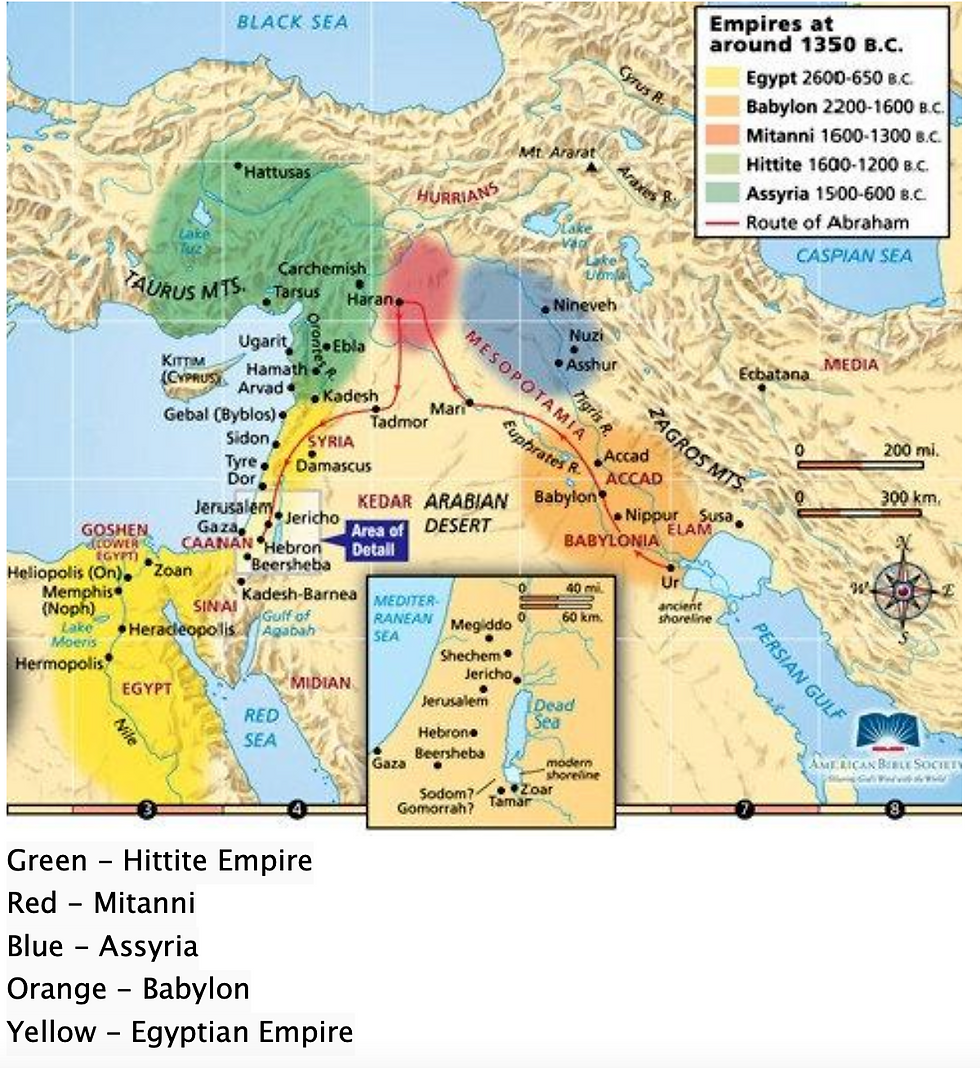
It was at this point in time when you started having repeated incursions of Semites, Hurrians and the Indo-European Hittites. Sargon's empire collapsed because of internal pressures and invasion of hillmen from the Zargos mountains of Iran. Out of this the Sumerian city-state system re-emerged with Ur (in Iraq) predominating. Although this was a stable empire, it too collapsed (c.2000BC) under the pressure of a new wave of invasions by Semitic tribes - the Amorites from the Syrian desert who gained control over the whole region from Syria to southern Mesopotamia, where they set up a number of small kingdoms, among which first Assyria (rose and then fell) and then Babylon gained prominence.Babylon rose to prominence under Hammurabi (1792-50BC).
The Early Mediterranean World:
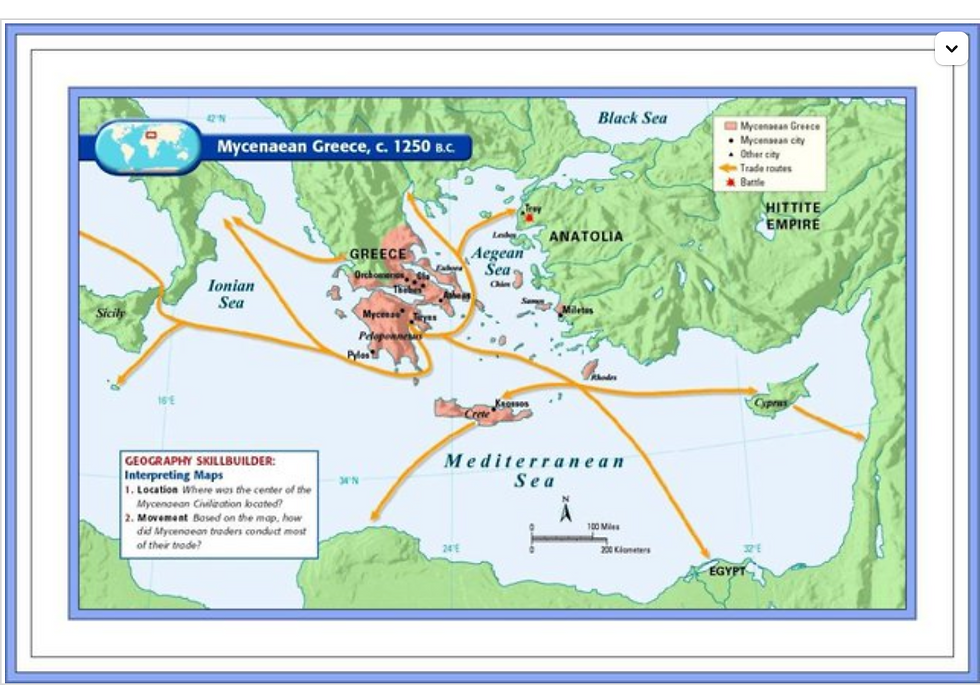
The earliest inhabitants of Greece and the Aegean islands were probably related to the Cretans. Shortly before 2000BC, the northern islands of Greece and parts of the mainland were invaded by peoples from Anatolia. But they never reached the island of Crete, so it was able to develop unencumbered and expanded it's colonies throughout the Aegean islands. This period of expansion reached it's apex at about 1500BC.
About 1450BC, invaders from the mainland of Greece conquered the island of Crete, burning towns and palaces. Eventually around 1300BC - the whole of the Aegean region became an empire of the Mycenaean.
Shortly before 1200BC,Mycenae was over run by invaders from perhaps Greece.
Armenians and Phrygians from the Balkans overthrew the Hittite empire in Anatolia. The groups that were displaced from these actions moved outward in search of new homes.
Those from the Hittite Empire in turn invaded Syria while the Hittite refugees who became known as the Sea Peoples from the coastal regions of Anatolia headed to Cyprus and Egypt, allying with the Libyans to attack Egypt who defeated them in 1232BC. Fifty years later the Egyptians defeated another coalition of these Sea Peoples.
Some of these Sea Peoples, including the Philistines then settled in Palestine.
Writing and many of the arts disappeared from the Aegean during this period of dislocation. But this was an age of technical advance, with iron replacing bronze for tools and weapons. The new Greek world was divided between hundreds of small independent communities or city-states linked by similar religions and dialects. Writing was eventually reintroduced using the Phoenician alphabet. In the eighth century BC a period of colonial expansion began. This epoch-making movement, caused by land-hunger, political oppression and the attraction of trade, changed the whole face of the Mediterranean and spread Greek civilization as far as the Black Sea in the east.
Egypt and the Near East,c.1600 - 330BC
Because of their fabulous wealth the lands of the Fertile Crescent were always subject to assault from barbarian charioteers from adjoining steppes and mountains, jealous of their civilization and greedy for their riches. Egypt alone was sheltered by the desert.
Even Egypt suffered defeat and rule by a foreign Asiatic people known as the Hyksos. By the time the Egyptians were able to retake rule,Egypt's greatest period marked by pyramid building was over. But in reaction to the Hyksos era,Egyptians started on a period of expansion almost to the Euphrates River, meant to stop anymore invasions.
It was during the period from 1600BC to 500BC that one empire after another fell to what was called “barbarian” outside tribes.The Hittite Empire fell about 1250BC from massive migrations from the Aegean who conquered rather than settled peacefully. Each group that was pushed out of it's native territory would then pressure another group in the next territory.
This power vacuum enabled the Israelites under David (c.1006BC - 966BC) to create a kingdom briefly controlling Palestine and Syria. But after Solomon (966-926BC) the kingdom, inherently unstable because of it's disparate tribal origins, quickly disintegrated. But change and fluidity, chaotic though their consequences were, had the effect of breaking down old geographical and cultural barriers and beginning the process of fusing the whole region into a single cosmopolitan society, over which, after 539BC Persia established hegemony.
(main source for information: "Concise Atlas of World History")
1200 BC – A period of momentous change - Alan Peatfield, UCD
1200 BC stands as one of those symbolic dates in human civilisation.
Its significance lies in its association with a period of momentous change, a period of catastrophic destruction and uncertainty for the people of the time.
We, with the benefit of hindsight, can see it as a prelude to the archetypal Dark Age that separates the splendours of the Eastern Mediterranean Bronze Age from the glories of Classical Greece and Rome.
1200 BC is, of course, a generic rather than an absolute date, one that stands for the sweep of the history of the time, rather than a single event. If a single event is needed to justify the association, probably it should be the victory over the invading alliance of “peoples from the sea” that Pharaoh Ramesses III recorded at the mortuary temple of Medinet Habu, sometimes dated to 1190 BC.
It is that vast movement of population, which current scholarship calls the “Land and Sea Peoples”, that lies at the heart of the changes in this period.
Egyptian, Ugaritic, and Hittite sources all record threats from large numbers of invaders at this time. The Egyptians in particular had recorded previous incursions by some of the ethnic groups they later included in the muster of the Sea Peoples, especially the Shardana, in the earlier reigns of Pharaohs Ramesses II and Merneptah. Indeed by 1175 BC, a more likely date for Ramesses III’s victory, the empire of the other great power of the age, the Hittites, had been destroyed, as had the independent Canaanite kingdoms, exemplified by the great mercantile city of Ugarit.
The kingdoms of Mycenaean Greece had already suffered a series of destructions in the 13th century, and the drawn-out end of the Mycenaean civilization is characterized by the collapse of the centralized economy, radical changes in settlement patterns, including migration out of Greece, loss of literacy, and even linguistic changes.
Later Greeks heroised this period with the myths and stories around the fall of Troy. In reality Troy was probably yet another of the the civilized cities of Asia Minor that fell prey to the military adventurers who thrived in the chaos of the period.
And chaos is a reasonably accurate description of the period.
The events recorded in documentary archives and inscriptions, and those visible archaeologically, do not present a neat timeline, nor do they offer a clear explanatory narrative of what happened, let alone why it all happened. Military destructions caused cultural discontinuity and population shift decades before 1200 BC, and for more than a century afterwards.
The resulting migrations, particularly of Greek-speakers to the Asia Minor coast and to Cyprus (the Greek colonies), or of mixed cultural groups to the Levantine coast (the Philistines), strongly influenced the cultural character and history of the region for centuries to come. Trying to establish some clarity for these events has exercised scholars since the Bronze Age was discovered.
For Further Study (Optional)
From The Timetables of History:
From 2500BC to 2001BC
Dynasty of Pharaohs in Egypt (2200BC to 525BC)
From 2000BC to 1500BC
Social unrest in Egypt
18th dynasty brings Egypt to height of its power and achievements
From 1600 to 500BC - Chaos Reigns and Hebrews, among others, comes onto the stage
From 1500BC to 1001BC
Phoenicians become the predominant trading power in Mediterranean area
Thutmose III (1480BC to 1450BC) extends Egyptian empire along eastern Mediterranean, to banks of Euphrates, and to upper Nile
Under peaceful reign of Amenhotep III(1420BC to 1385BC) Egyptian trade and culture flourish
20th dynasty in Egypt(1200BC to 1090BC); decline of power begins
The Israelites, led by Moses, leave Egypt, reach Canaan
Moses receives the Ten Commandments on Mount Sinai
Crossing of the Jordan by Israelites
Saul becomes first king of Israel (1002BC to 1000BC) and is defeated by Philistines
The first official mention of the Israelites is in an Egyptian victory hymn
Age of the "Judges" elected from 12 Israelite tribes
Beginning of true Iron Age in Syria and Palestine
From 1000BC to 901BC
Accession of David as king of united kingdom of Judah and Israel (1000BC to 960BC),with Jerusalem as capital; returns Ark of Covenant and Decalogue to city
King David is succeeded by his son,Solomon(960BC to 925BC),who builds Yahweh Temple in Jerusalem; under his rule, country reaches height of its civilization
Temple in Jerusalem has main aisle with vestibule, three-storied wings;Phoenician architects collaborate
Water supply system through reinforced subterranean tunnels built in Jerusalem
Division of Hebrew kingdom into Israel and Judah (935BC)
King Solomon dies (925BC),succeeded by his sons Jeroboam I as king of Israel (to 907BC), And Rehoboam I as king of Judah (to 917BC)
Sheshonk I of Egypt conquers and pillages Jerusalem


Comments