Astronomy - Week 35 - Kuiper Belt / Oort Cloud
- Aug 20, 2022
- 2 min read
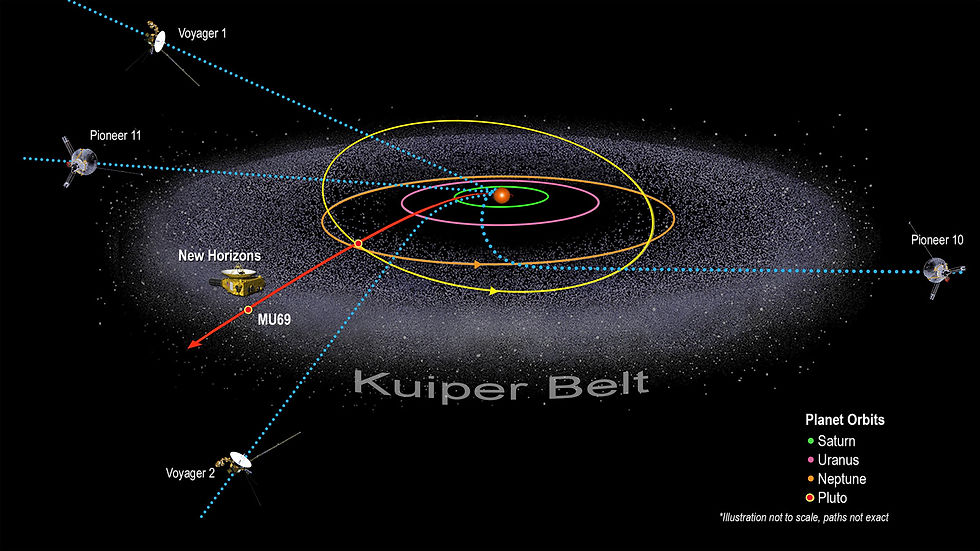

Kuiper Belt
From wiki:
The Kuiper belt extends out from the orbit of Neptune. It is similar to the asteroid belt, but it is much larger - 20 times as wide and 20-200 times as massive. It consists mainly of small bodies or remnants from the Solar System was formed. Many of the asteroids in the Kuiper belt are composed of rock and metal, but most of the astronomical objects in the Kuiper belt are composed of frozen ice made from methane, ammonia and water. Some of the moons in Neptune’s orbit may have originated in the Kuiper belt.


Oort Cloud

The Oort Cloud is like a big, thick bubble around our Solar System.
It is a giant spherical shell that surrounds the Sun, planets and Kuiper Belt Objects.
It is made of icy, comet-like objects. These can be as large as mountains or even larger.
From solar system.nasa.gov:
In the silence and darkness between the stars, where our Sun appears as just a particularly bright star, a theorized group of icy objects collectively called the Oort Cloud coast along their orbits like lazy moths around a porch light.
The Oort Cloud is the most distant region in our solar system, and it's jaw-droppingly far away, extending perhaps one-quarter to halfway from our Sun to the next star.
For comparison, Pluto’s more elliptical orbit carries it between about 30 and 50 astronomical units from the Sun. The inner edge of the Oort Cloud, however, is thought to be located between 2,000 and 5,000 AU from the Sun, with the outer edge being located somewhere between 10,000 and 100,000 AU from the Sun.
If those distances are difficult to visualize, you can instead use time as your ruler. At its current speed of about a million miles a day, NASA's Voyager 1 spacecraft won't enter the Oort Cloud for about 300 years. And it won’t exit the outer edge for maybe 30,000 years.
Unlike the planets, the main asteroid belt and many objects in the Kuiper Belt, objects in Oort Cloud do not necessarily travel in the same direction in a shared orbital plane around the Sun. Instead, they can travel under, over and at various inclinations, around the Sun as a thick bubble of distant, icy debris. Hence, they’re called the Oort Cloud rather than the Oort Belt.
Dutch astronomer Jan Oort proposed the existence of the cloud to explain (among other things) where long-period comets come from, and why they seem to come from all directions rather than along the orbital plane shared by the planets, asteroids and the Kuiper Belt.


------------------------------------------------------
Videos:
Professor Dave Explains
Evidence for Big Bang Cosmology - 12:18 min
Crash Course Astronomy #25 - Distances - 11:20 min


Comments